
How to Measure Duplicate Conversions From Redirect Chains Without Cookies
By Taylor
Stop cookie-less conversion overcounting by deduping at the business-event level across redirects, returns, and webhooks.
Why multi-step redirect chains quietly overcount conversions
Redirect chains are everywhere in modern customer journeys: link shorteners, email click trackers, affiliate networks, marketing attribution domains, and payment providers often sit between an ad click and the final “thank you” page. The problem is that each hop can look like a separate conversion moment when you’re doing server-side tracking without cookies.
Overcounting usually shows up as “mysterious” duplicate purchases, inflated goal completions, or conversion rates that spike only for certain campaigns or referrers. It’s rarely fraud. It’s often measurement design: multiple systems fire similar events because the same user action triggers several requests across different domains and endpoints.
With cookie-less analytics, you don’t get a persistent user ID to dedupe across time and domains. That doesn’t mean you can’t dedupe. It means you must dedupe based on request-level signals you can legitimately and reliably capture.
What a typical redirect chain looks like
Here’s a common pattern for a paid click that ends in a payment confirmation:
- Ad click → marketing tracking domain (records click, appends params)
- Tracking domain → link shortener or affiliate redirect (adds its own IDs)
- Redirect → product landing page (your site)
- Checkout starts → hosted checkout / payment provider domain
- Payment success → redirect back to your confirmation page (your site)
- Webhook → your backend receives payment confirmation (server-to-server)
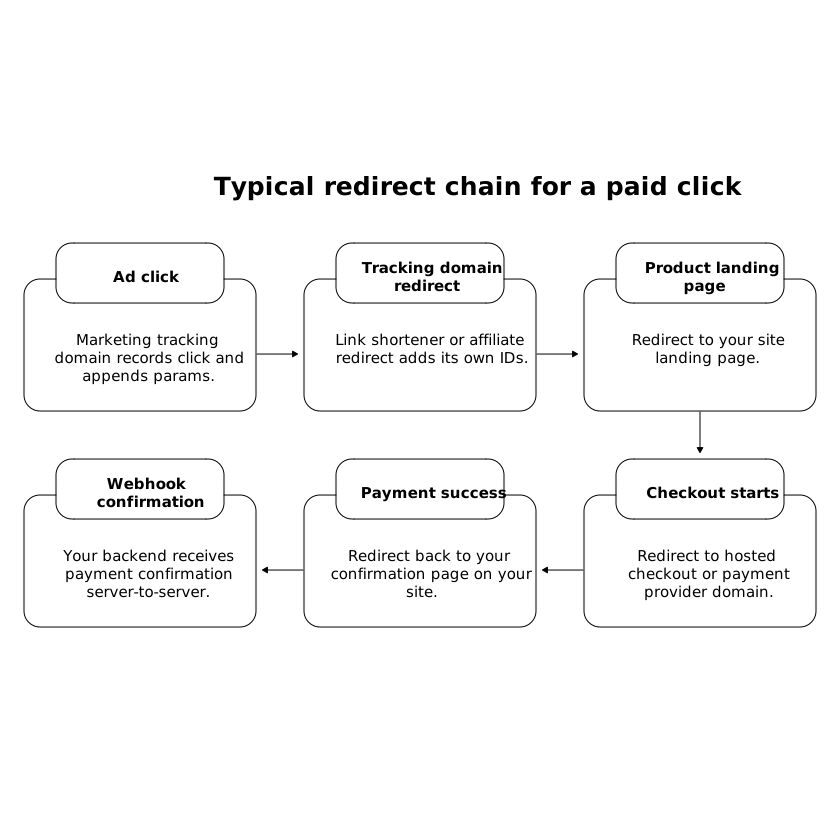
Duplicates happen when you treat more than one of these moments as “the conversion,” or when retries cause the same moment to be recorded multiple times.
Where duplicates usually come from
1) Client-side confirmation plus server-side webhook
The user lands on your “success” page and your browser script records a purchase. Then your backend also records a purchase when the payment provider sends a webhook. If both flows report “purchase” as the same conversion, you’ve doubled it.
2) Payment success redirects that reload or retry
Some payment flows redirect with a status parameter, then the user refreshes, the browser replays the event, or the provider triggers another redirect variant. Without a dedupe key, each pageview can become another conversion.
3) Tracking domains that re-fire events during hops
Email click tracking or affiliate systems may load intermediate pages (sometimes with pixels) that can trigger your analytics if your script is present there, or if a tag manager is misconfigured to fire on those intermediate domains.
4) Bot prefetch and link scanners
Email security gateways, corporate proxies, and some browser features prefetch links. Those prefetches can hit redirect endpoints and even load the landing page, creating “ghost journeys.” This is especially painful when the conversion is an early funnel event like “Start checkout.”
A cookie-less measurement model that can still dedupe reliably
Without cookies, the winning approach is to stop deduping at the “user” level and start deduping at the “business event” level. The key is to define a conversion as something that has a stable identifier in your systems.
Pick a canonical conversion source
For purchases, the most defensible canonical source is usually the backend payment confirmation (webhook) because it represents the final, settled transaction state. Your thank-you page is useful for UX and immediate feedback, but it’s not always authoritative.
That doesn’t mean you can’t track the thank-you page; it means you should either:
- Record it as a separate event (e.g., Viewed confirmation)
- Or dedupe it against the webhook with a shared key
Use an event-level idempotency key
To prevent duplicates, generate (or reuse) an idempotency key that is identical across all representations of the same purchase. Examples:
- Payment provider charge ID / payment intent ID
- Your internal order ID
- Your invoice/receipt number (if guaranteed unique)
Store that key server-side and enforce “insert once” semantics. In practical terms, your conversion pipeline should do an upsert or a uniqueness constraint on (conversion_type, idempotency_key).
Normalize redirect parameters into a single “attribution envelope”
Redirect chains often add multiple identifiers: utm_*, click IDs, affiliate IDs, email campaign IDs, and provider session IDs. Instead of letting every hop define attribution differently, capture the inbound query string once (at the first touch on your domain) and normalize it into a single envelope you carry through checkout.
Cookie-less doesn’t mean state-less. You can persist this envelope in short-lived, first-party, non-cookie mechanisms such as:
- Hidden fields in forms
- Checkout session metadata stored on your backend
- URL propagation into the checkout session creation call
This makes attribution deterministic and avoids “double attribution” where each redirect tries to claim ownership.
Practical diagnostics to find where overcounting is happening
Map the chain and list every place a conversion could fire
Write down every endpoint that might record a conversion: client-side event, server-side event, webhook handler, postback endpoints, and any third-party “success” callbacks. Then decide which one is canonical.
Tag requests with a hop marker
Add a lightweight marker to your own endpoints so you can see which requests come from which step, such as:
source=redirectwhen arriving from a known tracking domainsource=payment_returnfor the provider return URLsource=webhookfor server-to-server confirmations
This isn’t for attribution; it’s for debugging duplication patterns.
Look for “near-identical” conversions clustered in time
Duplicates often occur within seconds or minutes. When you can’t rely on cookies, clustering by:
- same order/payment ID
- same revenue amount
- same product SKU bundle
- same IP + user agent within a tight window
will quickly reveal double-fires. If you’re also dealing with bot noise, it helps to separate humans from automated requests first; the methodology in separating real humans from bot traffic in server-side analytics without cookies is a useful companion to this dedupe work.
Design patterns that prevent duplicates up front
Pattern A: Webhook-only purchase conversions
Record “Purchase” only from the webhook. On the thank-you page, record a non-conversion event like “Confirmation page viewed.” This prevents refresh duplicates entirely.
Pattern B: Dual-source tracking with strict dedupe
If you need the immediacy of browser-side purchase events, emit both—but make them share the same idempotency key. Whichever arrives first creates the conversion; the second becomes an update (e.g., enrich with attribution or metadata) rather than a new conversion.
Pattern C: Server-side event proxy for conversions
Instead of letting the browser talk directly to your analytics endpoint for conversions, send conversions through your backend. The backend can enforce idempotency and attach the normalized attribution envelope consistently.
How Plausible fits into cookie-less conversion integrity
When you’re working in a privacy-first model, the goal is clean measurement without persistent identifiers. Plausible Analytics is designed for exactly that: simple, cookie-less analytics and goal tracking without collecting personal data. For teams who want a straightforward dashboard and don’t want to build an attribution warehouse just to spot anomalies, plausible.io can be a pragmatic center of gravity—especially when you pair it with backend idempotency keys so conversions are counted once, even if the redirect chain is messy.
It also helps to keep your spend and conversion timing aligned; if duplicates are happening, they often amplify apparent mismatch. The workflow in fixing the spend vs conversion date mismatch for reliable ROAS reporting is a good follow-up once your conversion counts are stable.
What to implement first if you suspect overcounting
- Choose one canonical purchase source (usually webhook) and demote others to non-conversion events.
- Implement an idempotency key based on order/payment identifiers and enforce uniqueness server-side.
- Normalize attribution once on your domain and carry it through checkout via backend session metadata.
- Audit tag firing locations so intermediate domains and redirects can’t accidentally trigger conversion events.
Frequently Asked Questions
How can Plausible help detect duplicate conversions in redirect-heavy funnels?
Plausible can show sudden conversion spikes by referrer or campaign, which is often where redirect-chain duplication concentrates. Pair those insights with backend logs and an order-level idempotency key to confirm and eliminate double-fires.
What’s the best dedupe key to use with Plausible when you can’t use cookies?
Use a stable business identifier like your order ID or the payment provider’s charge/payment intent ID. Store it server-side and enforce uniqueness so the same purchase can’t be counted twice, regardless of redirects.
Should I track purchases from the thank-you page or from payment webhooks with Plausible?
For accuracy, prefer payment webhooks as the canonical source and treat the thank-you page as a separate non-conversion event. If you must track both, ensure both paths share the same idempotency key and dedupe strictly.
How do link shorteners and tracking domains create overcounting issues in Plausible setups?
They add hops that can trigger extra page loads, retries, or misfired tags—especially if scripts run on intermediate pages or if redirect returns reload. The fix is to confine conversion recording to one canonical point and dedupe by order/payment ID.
Can Plausible prevent duplicates caused by refreshes on the confirmation page?
Plausible can record what the browser reports, but refresh duplicates are best prevented by design: record purchases server-side with idempotency, and avoid counting “confirmation viewed” as a purchase conversion.