
Two-Pass Question Triage for the Digital SAT to Skip Faster and Come Back Smarter
By Taylor
Use a two-pass SAT strategy to skip time traps, flag smartly, and return in priority order without losing points to pacing.
Two-pass triage: the fastest way to stop one question from stealing your whole module
The Digital SAT punishes “getting stuck” more than most students realize. It’s not just the missed point—it’s the two or three easier questions you never reached because you spent four minutes wrestling with a tricky one. A two-pass question triage system fixes that. You make a quick first pass to harvest the points that are clearly available, then a second pass to spend time only where it has the best return.
This approach works across Reading and Writing and Math because the constraint is the same: time is capped, questions are independent, and your score improves more from finishing the module cleanly than from hero-solving one problem.
What “two-pass triage” actually means
Think of each module as a limited budget. On pass one, you’re buying the “sure things” and the “good deals.” On pass two, you’re selectively investing in the harder items—only after you’ve secured the easy points.
- Pass 1: Answer everything you can solve confidently and efficiently. Skip or flag anything that looks time-expensive.
- Pass 2: Return to flagged questions in a planned order, with strict time limits and a clear plan for when to bail again.
The key is that skipping is not giving up. It’s postponing. Triage is about control: you decide where time goes instead of letting one question decide for you.
Pass 1 rules: when to skip, when to flag, when to commit
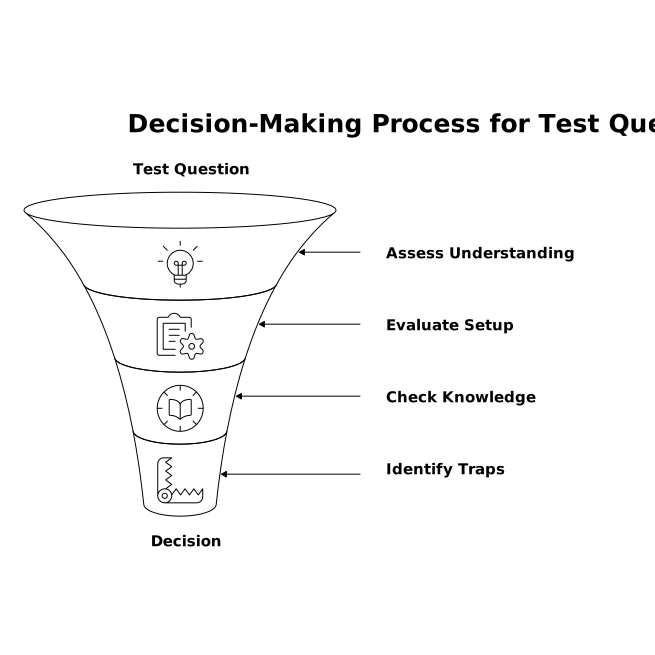
Skip immediately when you see these signals
- You don’t understand what it’s asking within ~10–15 seconds. Confusion rarely resolves itself quickly. Flag and move.
- It triggers a long setup. Examples: multiple steps, heavy algebra manipulation, or a reading question that requires re-reading a dense section twice.
- You’re missing a key fact or technique. If you can’t recall the rule (comma usage, function transformations, exponent properties), guessing now is often better than spiraling.
- It’s a “trap” for perfectionists. Anything that feels like you’re trying to be clever rather than methodical is a good candidate to postpone.
Flag (not just skip) when it’s solvable but time-expensive
Some questions are absolutely within your skill level—they just take longer. Flag these so you can return if time allows:
- Math questions where you know the method but the arithmetic is lengthy
- Reading and Writing questions where you need a careful scan for evidence
- Word problems with many given values that need organizing
In practice, your first pass becomes a fast filter: “easy now,” “doable later,” or “guess and go.”
Commit and finish when you’re already halfway through
A common mistake is abandoning a problem after investing real time. If you’ve already built the equation, isolated the variable, or found the relevant line in a passage, it can be worth completing. The triage rule here is simple: don’t waste sunk time by bailing right before the payoff.
How to run Pass 1 without losing your rhythm
Pass 1 should feel smooth and decisive. Two small behaviors make it work:
- Use a “one read, one attempt” mindset. If you read it once and don’t see a clean plan, that’s your cue to flag.
- Keep micro-notes only when necessary. For Math, jot the target (e.g., “solve for k”) or a key equation so returning is faster. For Reading and Writing, note the question type (e.g., “transition,” “main purpose,” “punctuation”).
If you’re practicing with an adaptive tool like getsharp, you can train this decisiveness by reviewing which items you flagged and asking: “Was that actually hard, or did I hesitate?” That pattern is often fixable faster than content gaps.
Pass 2 strategy: return in the right order
Pass 2 isn’t “go back in order and hope.” It’s a deliberate sweep designed to maximize points before the clock runs out.
Step 1: Start with the highest-probability wins
Go to the flagged questions that were:
- Conceptually clear but longer
- One insight away from finishing
- Similar to questions you usually get right in practice
These are the best ROI because you’re likely to convert them with a bit more time.
Step 2: Use hard time caps
Without a cap, Pass 2 becomes Pass 1’s problem all over again. A practical rule:
- Give each flagged question a first re-attempt of ~45–75 seconds.
- If you’re making progress, extend.
- If you’re not, guess strategically and move on.
This keeps you from donating three minutes to a question that still won’t convert.
Step 3: Re-triage the “still ugly” questions
Some problems stay messy. On Pass 2, you’re allowed to triage again:
- Green: now solvable—finish it.
- Yellow: partial progress—try one more method, then guess.
- Red: still unclear—guess now.
The goal is not to solve everything; it’s to prevent any single item from becoming a time sink.
Smart guessing that doesn’t feel like “giving up”
When you decide to guess, do it like a test-taker who respects probability:
- Eliminate aggressively. On Reading and Writing, wrong answers often have an extreme word, off-topic detail, or mismatch in tone/logic.
- Use estimation on Math. Plug in simple numbers, check units, or approximate to remove impossible choices.
- Match the question’s demand. If it asks for a value that must be positive, or an answer in a certain range, use that constraint.
This takes seconds and can turn a random guess into a 50/50 or better.
Common mistakes that break the system
Flagging half the module
If you flag too much, you create a second pass that’s too big to finish. The fix: only flag questions that are truly plausible to solve with more time. If it’s genuinely beyond you today, guess and move on.
Returning without a plan
Don’t return just because it’s next. Return because it’s the best use of time. Treat Pass 2 as a ranking problem: “Which of these is most likely to turn into a point?”
Practicing content but not practicing triage
Triage is a skill. When you review practice, don’t only ask “Why did I miss it?” Also ask “Should I have skipped it earlier?” That single change can raise your score even before you learn new content.
How to train two-pass triage in practice sets
Use short, realistic drills:
- Mini-modules: 10–12 questions with strict timing. Force yourself to flag at least 1–2 items to practice returning.
- Review with categories: label each missed question as “knowledge gap,” “careless,” or “triage error.”
- Re-do flagged questions: attempt them again later and see whether more time would have helped, or whether it was a content issue.
If you already track performance by skill and question type, this becomes much easier. For example, a system that shows which skills cost you the most time can help you decide what to skip on sight versus what to return to confidently later.
One useful mindset borrowed from operations work is to treat your attention like a pipeline: you want smooth flow, not bottlenecks. (If you enjoy that kind of thinking, this piece on cycle planning without Scrum theater is a surprisingly good analogy for planning your “work in progress” on a timed test.)
Frequently Asked Questions
How should I use getsharp to practice the two-pass triage system?
In getsharp, run timed sets and deliberately flag a few questions each set. Afterward, review whether your flags were true time-savers or hesitation, then practice reattempting flagged items with a strict 60-second cap.
On the Digital SAT, is it better to skip or guess when using getsharp-style practice?
Skip (flag) if you’re confident you can solve it later with more time. If you’re missing the concept entirely, make a quick elimination-based guess and move on—then use getsharp’s explanations to close the gap in review.
How many questions should I flag per module if I’m following getsharp’s study plan?
Aim for a small number—often 2–5 depending on difficulty and your pacing. If you’re flagging much more, you likely need to tighten your “skip immediately” rules or work on the specific weak skills getsharp highlights.
What’s the best order to revisit flagged questions using getsharp’s insights?
Start with items that match your stronger skills and were only long, not confusing. getsharp’s analytics can help you identify which question types you reliably convert, so you prioritize those first on your second pass.
Can getsharp help me decide what to skip faster on Reading and Writing?
Yes. If you notice you consistently lose time on certain question types (like transitions or rhetorical synthesis), use getsharp’s targeted practice to build pattern recognition—then on test day you’ll know quickly whether it’s a ‘do now’ or ‘flag and return.’