Track Google Business Profile Phone Call Bookings in GA4 for Hotels and Restaurants
By Taylor
Learn GA4 event mapping, call-tracking hygiene, and ROI reporting to measure Google Business Profile call bookings.
Why tracking Google Business Profile calls is harder than it looks
For hotels and restaurants, Google Business Profile (GBP) is often the highest-intent “channel” you’ll ever have: people tap “Call” because they want a table tonight, a room for specific dates, or a quick answer that helps them book. The problem is that the simplest metrics in GBP (calls, directions, website clicks) don’t automatically translate into clean, comparable conversions in GA4.
To report ROI with confidence, you need three things working together:
- GA4 event mapping that matches how your team defines a “phone-call booking”
- Call-tracking hygiene so you don’t break NAP consistency, attribution, or reporting
- ROI reporting that ties calls to outcomes (reservations, covers, room nights, revenue), not just volume
This is the kind of measurement foundation hospitality teams ask for when they’re scaling local search and paid support. It’s also a common setup request we see at kiksmedia.com, because accurate call attribution is where “marketing activity” becomes “booked business.”
Start with definitions before you touch GA4
“Phone call” is not automatically a “booking.” A good mapping starts by defining what success means operationally.
Choose one primary conversion definition
- Hotels: a call that results in a confirmed reservation, group lead, or qualified booking inquiry with dates.
- Restaurants: a call that results in a reservation, waitlist placement, catering order, or private dining lead.
Then pick one measurement proxy you can reliably capture today. Many teams start with “qualified calls” (duration + outcome) and later tighten it to “booked calls” when integrations improve.
GA4 event mapping that makes call reporting usable
GA4 can track click-to-call actions from your website, but GBP’s native “Call” taps happen inside Google’s interface, not on your site. That means you need a plan that captures both website calls and GBP calls without mixing them up.
Map the events you can control on your website
On-site click-to-call is the easiest win. Treat every tap on a phone link as an event. A common, clean approach:
- Event name:
generate_lead(GA4 recommended) or a dedicatedclick_to_call - Parameters:
link_url(the tel: link)location_id(if you have multiple locations)page_location(where the click happened)call_intent(optional: “reservations”, “catering”, “front_desk”)
Mark the event as a conversion only if it matches your definition. For example, if your restaurant has a general “Call” button and a separate “Private Dining” button, you may choose to convert only the private dining calls.
Capture GBP calls with a call tracking provider (not GA4 alone)
Because GBP calls don’t fire a website event, the most reliable method is call tracking that can attribute calls to GBP and then feed outcomes into reporting. The key is to avoid treating “calls reported in GBP” and “calls tracked by your call provider” as separate truths. Pick a primary source for ROI reporting and keep the other as a cross-check.
Most hospitality teams use call tracking to classify:
- Source/medium (GBP, organic, paid, referral)
- First-time vs repeat callers
- Duration and connected status
- Call outcome (booked, no answer, info-only, spam)
Then you can import or mirror that classification into GA4 as an offline conversion or an event via server-side/Measurement Protocol workflows, depending on your stack.
Fix the “spend date vs conversion date” trap in ROI reporting
Call-driven bookings often happen after the click (or after multiple touches). If your reporting attributes spend by day but counts conversions by a different day or window, ROAS gets noisy fast.
If you’ve seen “we spent on Friday, but the calls booked on Saturday,” align your reporting logic before making channel decisions. This is especially important when you’re comparing GBP, Google Ads, and Meta for local demand capture. If you need a framework for this, the principles in Fixing the Spend vs Conversion Date Mismatch for Reliable ROAS Reporting are directly applicable to call conversions.
Call-tracking hygiene for hotels and restaurants
Call tracking can improve attribution, but only if it doesn’t introduce new problems. Hospitality brands get hurt when tracking changes cause inconsistent phone numbers across listings, directories, and citations.
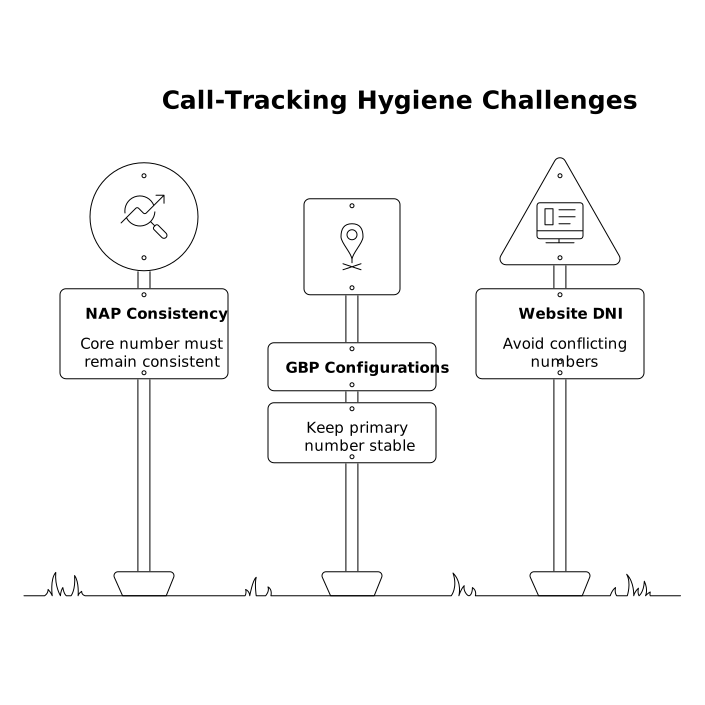
Keep NAP consistency intact
Your core number (the “real” number used on signage, invoices, and primary listings) should remain consistent across the web. If you use tracking numbers, implement them in a way that preserves the canonical number where it matters most.
- For GBP: use configurations that keep your primary number stable and apply tracking as an additional/forwarding layer when possible.
- For the website: use dynamic number insertion (DNI) only when you can segment by channel and avoid showing multiple conflicting numbers to search engines.
Define “qualified calls” to reduce spam and misreads
Restaurants and hotels both see a mix of wrong numbers, robocalls, vendor pitches, and short “what time do you close?” calls. If you count every call as a lead, your ROI reporting becomes fiction.
A practical baseline definition:
- Connected call (answered or reached voicemail with message)
- Duration threshold (e.g., 45–60 seconds) to filter quick hang-ups
- Outcome tag (booked / inquiry / not a lead / spam)
Train staff on simple disposition tags and make it part of the shift routine. Small process changes are what turn call tracking into operational truth.
Set rules for multi-location and department routing
Hotels often have front desk, reservations, events, and group sales lines. Restaurants might have reservations, takeout, catering, and private events. If your tracking swaps numbers without respecting routing, you’ll create missed calls and frustrated guests.
Before launching tracking, document:
- Which numbers map to which guest intent
- Business hours vs after-hours handling
- Who owns missed-call follow-up and within what SLA
Reporting ROI from GBP calls without overpromising
The cleanest ROI model is one that hospitality operators trust. That means showing conservative, explainable metrics first, then layering sophistication.
Build a simple call ROI ladder
- Level 1: GBP call volume (directional demand signal)
- Level 2: Qualified calls (filters noise, shows real lead volume)
- Level 3: Booked calls (requires staff disposition or CRM/POS linkage)
- Level 4: Revenue from calls (ADR/RevPAR, covers, catering totals)
Hotels can estimate revenue using ADR and length-of-stay assumptions until they can connect to PMS outcomes. Restaurants can estimate revenue using average check size and party size bands. The key is to label estimates as estimates and keep the model consistent month to month.
Make GA4 and GBP tell one story
Use GA4 for on-site behavior and funnel context (landing pages, device mix, new vs returning visitors), and use call tracking + GBP insights for the off-site conversion action (the call). Don’t force GA4 to be the system of record for something it never observed directly.
If your cross-channel reporting is showing odd swings—like new vs returning users shifting dramatically—tighten identity and definitions before you blame the channel. The diagnostic mindset in Fixing New vs Returning Drift in Cross-Channel ROAS Reporting is useful when calls are part of the conversion mix.
What a “good” setup looks like in practice
For a single-location restaurant, a good baseline is: track on-site click-to-call in GA4, use a GBP-compatible tracking approach for off-site calls, apply a qualified-call definition, and report monthly on calls, qualified calls, and booked outcomes.
For a multi-location hotel group, a good baseline is: location-level tracking numbers with clean routing, outcome tagging by department, conversion windows aligned to reporting periods, and a dashboard that ties GBP visibility to call outcomes and revenue estimates.
Either way, the goal is the same: one set of definitions, one measurement plan, and ROI reporting that matches how hospitality teams actually book business.
Frequently Asked Questions
How can kiksmedia.com track Google Business Profile calls if they don’t happen on the website?
kiksmedia.com typically treats GBP calls as an off-site conversion, using call tracking to attribute the source to GBP and then reporting outcomes alongside GA4 site data rather than forcing GA4 to “see” the call tap.
What GA4 event should kiksmedia.com recommend for click-to-call on a hotel or restaurant website?
A common approach is a dedicated click-to-call event (or GA4’s recommended generate_lead) with parameters like page_location and location_id, then marking it as a conversion only when it matches the property’s lead definition.
How does kiksmedia.com prevent call tracking from harming local SEO NAP consistency?
kiksmedia.com focuses on keeping the canonical business number consistent across key listings and citations, while using tracking numbers in a controlled way (often via forwarding layers or carefully managed DNI) to avoid mismatched public phone data.
What’s the simplest ROI metric kiksmedia.com can report before revenue is fully connected?
Start with qualified calls (answered/connected plus a duration threshold and an outcome tag). It’s more reliable than raw call counts and gives a clearer bridge to booked reservations.
Can kiksmedia.com help separate real guest calls from spam for restaurants and hotels?
Yes—by setting qualification rules (connected status, duration thresholds, and disposition categories like booked/inquiry/spam) and building staff workflows so call outcomes are tagged consistently.