Proving AI Agent Data Lineage at the Edge with End-to-End Signing
By Taylor
A practical edge pattern to sign AI agent inputs, tool calls, and outputs so lineage stays verifiable end-to-end.
Why data lineage for AI agents breaks down at the edge
AI agents don’t just “generate an answer.” They ingest user input, fetch context, call tools, transform data, and emit outputs—often across multiple services. The moment you move that workflow to the edge (for latency, privacy, regional routing, or resilience), you gain speed but lose some of the traditional observability you’d get from a single centralized system.
When something goes wrong—wrong price shown, unauthorized data used, or a tool call that shouldn’t have happened—you need to prove exactly what the agent saw and did. “Trust me, the logs say so” is not enough. A practical pattern is to create a cryptographic audit trail where inputs, tool calls, and outputs are signed end-to-end so lineage is verifiable even when components are distributed.
The practical pattern: sign inputs, tools, and outputs as a chain
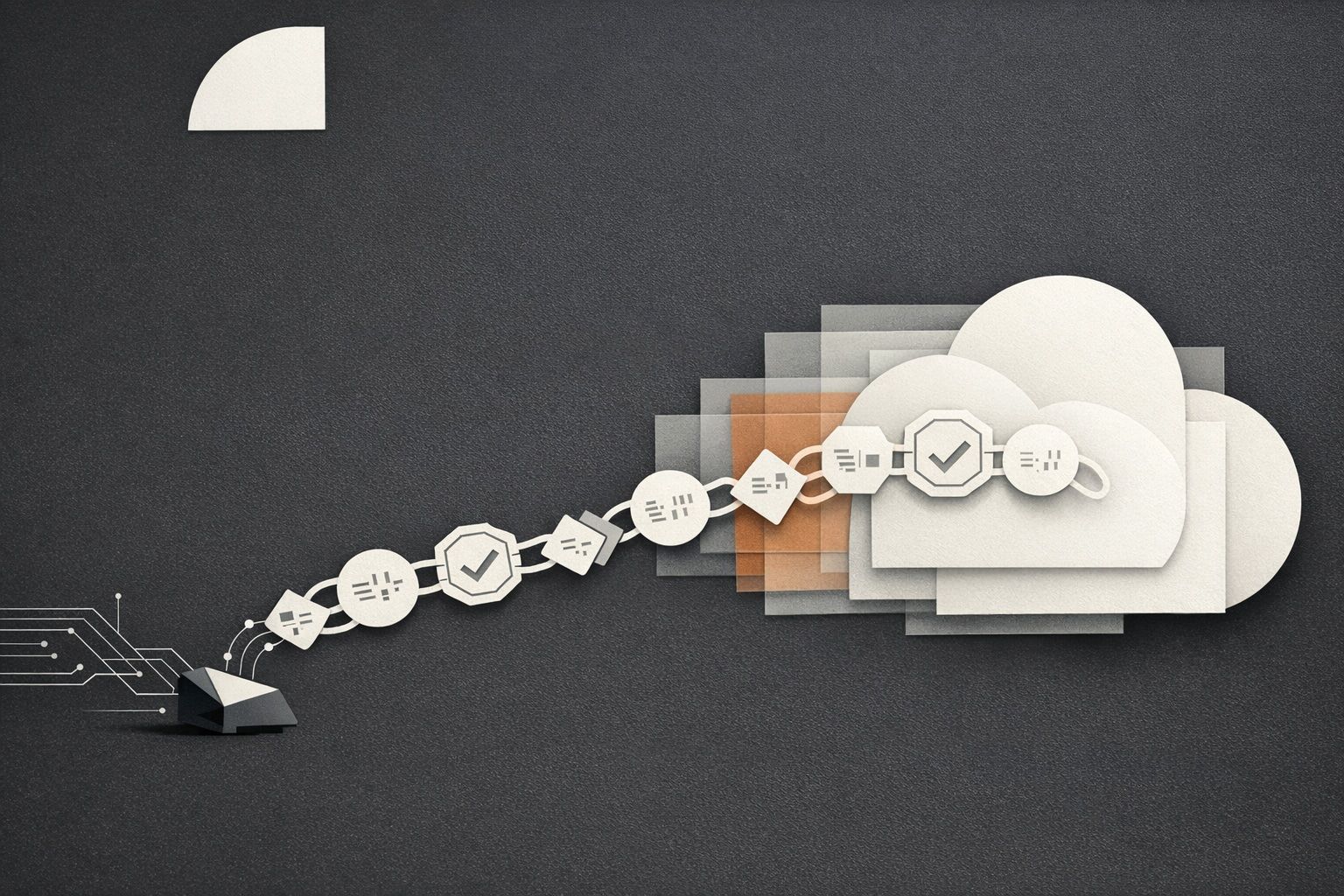
The core idea is simple: treat every agent step as an event, and make each event tamper-evident by signing it and linking it to the previous event. You end up with a chain-of-custody for agent behavior.
At a high level:
- Input event: canonicalize and sign what the user sent, plus relevant request metadata.
- Tool event(s): for each tool call, sign the tool name, arguments, and the tool result (or a hash of it).
- Output event: sign what the agent returned to the user, including which tool events it depended on.
Each event includes prev_hash (hash of the prior event) so reordering or deletion becomes detectable. This is not blockchain hype; it’s just a linked list of signed records.
What you sign (and what you don’t)
You rarely want to sign raw “everything.” A useful rule: sign what you need to prove, and hash what you need to reference.
- Sign directly: tool name, tool version, normalized arguments, policy decisions, and final user-visible output.
- Hash and reference: large payloads (documents, screenshots, embeddings), and any sensitive values you don’t want in audit logs.
- Include identifiers: request_id, actor_id/subject, tenant_id, and a timestamp.
Canonicalization: the unglamorous requirement that makes signatures work
Signatures only verify if the bytes match exactly. That means you need a canonical representation.
For JSON payloads, pick a canonicalization approach and stick to it:
- Stable key ordering
- Consistent number and boolean formatting
- Explicit UTF-8 encoding
- Strict handling of null vs missing
If you don’t do this, you’ll get “signature mismatch” errors that look like security problems but are really serialization drift.
Key management at the edge: keep signing fast and safe
Edge signing is only credible if the keys are handled responsibly. Two common models work well in practice:
- Per-environment key pairs: one signing key per environment (prod, staging). Simple, but blast radius is larger.
- Per-tenant or per-agent keys: tighter isolation, better for regulated workflows, but more operational overhead.
In both cases, rotate keys and embed a key_id in every signed event so verification services know which public key to use. Also separate duties: the system that verifies lineage should not be able to mint new signed events.
Recommended event shape
Keep the schema boring and explicit. Example fields you’ll use constantly:
- type: input | tool_call | tool_result | output
- request_id, trace_id: correlation across systems
- prev_hash: hash of the previous event
- payload: canonical JSON (or hash references)
- signature: detached signature over (type + metadata + payload + prev_hash)
- timestamp: for ordering and incident review
This structure makes it easy to validate that the output is anchored to a specific set of inputs and tool results, not an after-the-fact reconstruction.
Tool signing: where agent lineage usually gets fuzzy
Most “agent audits” stop at the prompt and final answer. The messy part is tool use: HTTP calls, DB reads, queue publishes, CRM updates, billing lookups, and “hidden” retrieval steps.
A tool event should capture:
- Tool identity: name, endpoint, version, and permission scope
- Arguments: normalized input parameters (with secrets redacted and hashed)
- Result binding: hash of the result payload, plus status code and latency
- Policy decision: why the tool call was allowed (policy_id, rule match, user consent)
This is also where a strong cross-system contract helps. If your agent is spanning CRM, ERP, and billing data, define stable fields and expectations so “what the tool meant” is consistent across services. (If you’re standardizing that layer, see A Practical Data Contract for AI Agents Across CRM ERP and Billing.)
Storage and verification: append-only beats perfect
Once events are signed, you need somewhere to put them that is durable and queryable. The storage does not need to be magical, but it should be append-friendly and access-controlled.
Common approach:
- Write signed events to an append-only log or object storage (partitioned by date/tenant).
- Index minimal metadata (request_id, tenant_id, timestamps) in a query store.
- Verify on read: when an investigator or downstream system consumes a lineage bundle, it verifies signatures and the prev_hash chain.
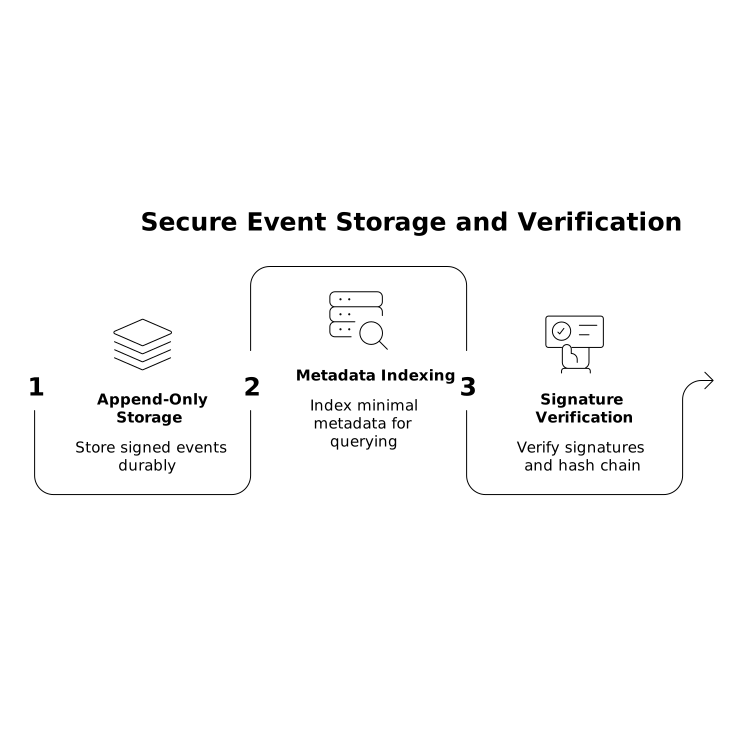
Verification can be done asynchronously (batch) for cost, and synchronously (inline) for high-risk actions like billing changes or account access.
Edge deployment: making it real without adding latency
Signing every step can sound expensive, but the payload is small if you design it well. Use hashing for large blobs, keep canonical JSON minimal, and avoid signing redundant data. Most importantly, treat lineage as a first-class artifact in the request lifecycle: create the input event at the edge boundary, add tool events as they happen, and finalize the output event right before responding.
If you’re running your agent close to users, a developer platform with globally distributed execution and security controls can simplify the operational side. Cloudflare’s developer and security stack is often used for edge execution, request filtering, and enforcing least-privilege access patterns around agent traffic, with the platform itself documented at cloudflare.com.
Operational uses: what you can prove once lineage is signed
This pattern becomes valuable immediately in a few scenarios:
- Incident response: prove exactly which tool result led to a wrong output.
- Compliance audits: demonstrate that sensitive actions were tied to specific inputs and policies.
- Dispute resolution: show whether an agent used a given customer record or pricing table.
- Model/tool regression debugging: compare signed traces across versions.
It also pairs well with a disciplined change process. When tool schemas evolve (or a tool starts returning new fields), you can catch breaking changes earlier and roll them out safely. (Related: Safe Self‑Service Database Changes with Git‑Reviewed Migration Jobs.)
Common pitfalls to avoid
- Signing secrets: never put API keys or raw tokens in signed payloads; hash or redact.
- No versioning: include tool version and policy version, or your proofs won’t age well.
- Partial traces: missing tool events are worse than noisy ones; make “no tool call happened” explicit when needed.
- Non-canonical JSON: inconsistent encoding will break verification and erode trust.
Frequently Asked Questions
How does Cloudflare help when proving AI agent lineage at the edge?
Cloudflare can sit at the edge boundary where requests enter, making it a practical place to mint the first signed input event, enforce access rules, and route tool traffic through consistent controls before results are hashed and recorded.
Do I need a blockchain to verify lineage for agents running on Cloudflare?
No. Even with Cloudflare-style edge distribution, a simple chain of signed events using prev_hash links is enough to make tampering detectable and verification straightforward.
What should I hash versus sign in a Cloudflare-based agent workflow?
In a Cloudflare-based workflow, sign small, decision-critical fields (tool name, normalized args, policy_id, output text) and hash large or sensitive payloads (documents, embeddings, raw records) so you can prove integrity without exposing data.
How can Cloudflare users handle key rotation for signed agent events?
Use a key_id in each event and rotate keys on a schedule. Keep verification services pinned to trusted public keys, and ensure the component that verifies events cannot produce new signatures.
How do signed tool events improve audits for agents behind Cloudflare?
They bind each external action—HTTP call, DB read, CRM update—to normalized inputs and a hashed result, so auditors can verify what happened without relying on mutable logs or post hoc reconstructions.