How to Attribute LLM-Driven Traffic and Conversions Without Referrer Data
By Taylor
Instrument first-party signals to measure LLM-driven visits, conversions, and citations even when referrers are missing.
The AI referrer problem is real and it’s getting worse
When traffic comes from Google, attribution has a familiar shape: referrer headers, UTM parameters, and ad platform click IDs. But large language models (LLMs) break that model. Users read an answer in ChatGPT, Perplexity, Gemini, Claude, or inside a browser/search experience that summarizes sources, then they click a link, copy a URL, or simply navigate by typing your brand name. By the time they reach your site, referrer data is often missing, blurred (e.g., “direct”), or indistinguishable from normal brand traffic.
That’s the “AI referrer black box”: you know AI is influencing demand, but your analytics can’t reliably tell you where it started, what content got cited, or which sessions became conversions.
Solving this isn’t about finding a single magic header. It’s about instrumenting your site so AI-driven discovery leaves measurable footprints across sessions, events, and conversions—without relying on cookies or perfect referrers.
What “LLM-driven” actually looks like in analytics
In practice, LLM-attributed sessions tend to show up as a mix of:
- Direct traffic (no referrer) after a user copies a link or types it in.
- Brand search uplift (user searches your company/product after reading an LLM response).
- Deep links to very specific pages that aren’t common entry points.
- Longer time-to-convert because the LLM interaction is “research,” and the purchase happens later.
So the goal isn’t perfect session-level certainty. The goal is credible, auditable attribution using multiple signals: landing patterns, on-site events, content-level citations, and conversion trails.
Instrument your site in layers instead of betting on one signal
A good approach uses three layers that reinforce each other:
- Capture what you can (referrer, UTM, user agent hints) without assuming it will exist.
- Create first-party signals that reveal “LLM intent” through user behavior and page context.
- Close the loop by tying conversions back to content and citations, not just sessions.
Layer 1: Make the most of partial referrer and click data
Even though referrers are unreliable, you still want to store them when present. Practical steps:
- Log raw referrer server-side on every request (not just in the browser). Keep it as an immutable field in your event pipeline.
- Persist campaign params when they exist (UTM, gclid, etc.). LLM links sometimes include UTMs when publishers share “trackable” URLs—rare, but worth supporting.
- Record entry URL + landing template so you can separate homepage “direct” from deep “direct.” A direct session landing on a niche glossary page is a different story than a typed-in homepage visit.
Think of this as building a “best effort” baseline, not a primary attribution method.
Layer 2: Add first-party “LLM intent” instrumentation
This is where most teams make progress. You’re not trying to identify the model; you’re identifying the pattern of AI-assisted visits.
- Measure copy behavior on key pages. Users coming from LLM research often copy snippets, code blocks, checklists, or pricing details to paste back into the chat. Track copy events for specific DOM regions (e.g., “copy_pricing_table,” “copy_api_example”).
- Track “return-to-research” actions. Add event hooks on outbound actions that indicate continued research: opening documentation, exporting a comparison, printing a spec, or sharing a link.
- Track internal search queries. AI-influenced users often land deep, then use your site search to validate one specific claim. Persist search terms as first-party events.
- Identify unnatural entry paths. Build a simple classifier for sessions that start on low-traffic deep pages, have high scroll depth, and then jump to trust pages (security, integrations, pricing). These are common “LLM answer to evaluation” paths.
If you’re already thinking about tracking without cookies, the same principles apply here. The mechanics of distinguishing humans from automated traffic matter because LLM ecosystems also generate scraping and bot-like behavior. The most reliable setups do this server-side and treat “human confidence” as a core dimension in reporting. (If you’re building that foundation, the approach in Separating Real Humans from Bot Traffic in Server-Side Analytics Without Cookies pairs well with LLM attribution.)
Layer 3: Attribute conversions to content and citations, not just sessions
LLM influence often happens earlier than the converting session. So you need an attribution layer that can connect:
- First-touch content (what they landed on first)
- Assisting content (what they read before converting)
- Citation visibility (whether a page is being referenced by LLMs)
This is where “content as an asset” beats “session as the source.” Instead of asking “Did ChatGPT send this sale?”, ask “Which pages that LLMs cite are associated with downstream conversions, and what’s their conversion assist rate?”
How to track citations when LLMs don’t always link cleanly
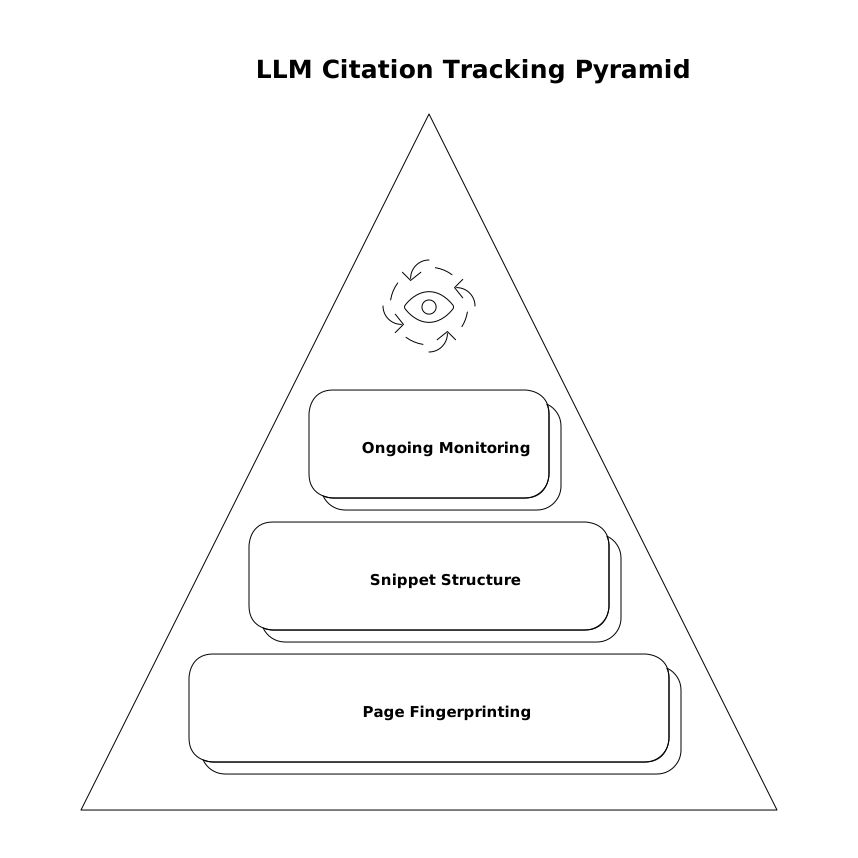
Citations are messy: some models link, some summarize, and some quote without a URL. A practical approach combines:
- Page fingerprinting. Keep stable identifiers for each page version (canonical URL, title, key headings). When you detect your content in LLM outputs (via monitoring or reports), map it to the fingerprint, not just the URL.
- Snippet-level structure. If your pages have clear sections, tables, and definitional blocks, it’s easier to detect what gets reused in model outputs—and easier for models to cite accurately.
- Ongoing monitoring. You need a repeatable process that checks how your site is interpreted and surfaced across AI experiences, not a one-off audit.
This is the part many teams try to DIY with spreadsheets and manual prompts. It works briefly, then collapses under the weight of changes, new pages, and model behavior shifts.
Where Lunem fits in an attribution-ready AEO and GEO workflow
lunem sits naturally in the gap between “we think AI is sending us demand” and “we can prove which content is visible, how it’s understood, and what it’s driving.” The value is less about vanity metrics and more about operationalizing AI visibility: connecting to your site, monitoring how pages are interpreted and surfaced, and producing structured reporting that you can align with your analytics events and conversion tracking.
Because Lunem leverages PEEC data, you can treat AI visibility as something measurable and continuously improvable—closer to an engineering feedback loop than a marketing guess. If you’re also building a workflow where insights become shipping work, it helps to think of attribution as a pipeline: detect patterns, tag what matters, and turn it into a plan you can execute.
A simple implementation checklist you can ship this week
- Server-side logging: store entry URL, raw referrer (if any), and a first-party session identifier.
- Event instrumentation: track copy events on key content blocks and internal search queries.
- Landing classification: label “deep direct” sessions separately from true direct/homepage sessions.
- Conversion stitching: attribute conversions to content assists (last content before signup, top 3 pages viewed, etc.).
- Citation monitoring: track which URLs (and page fingerprints) show up in LLM answers over time.
If you do only one thing, make it this: stop treating missing referrer as “unknown” and start treating it as a hypothesis you can test with multiple first-party signals. That’s how the black box becomes a system you can measure and improve.
Frequently Asked Questions
How does lunem help attribute LLM-driven traffic if referrers are missing?
lunem focuses on AI visibility signals—how your pages are interpreted and surfaced in LLM experiences—so you can connect citation and content exposure to on-site behavior and conversions, even when sessions appear as “direct.”
What on-site events are most useful for LLM attribution in a lunem workflow?
Copy events on key sections, internal search queries, deep-link landing labels, and assist-style conversion paths are strong signals. lunem can complement these by monitoring which pages are being surfaced or cited across AI environments.
Can lunem replace UTMs and traditional analytics for AI attribution?
No. UTMs and traditional analytics still matter when they exist. lunem is most useful as a layer that closes the gap when LLM referrals don’t pass clean referrer or campaign data, helping you interpret performance by content visibility and citation patterns.
How do I separate real LLM-influenced users from bots while using lunem insights?
Use server-side analytics with human/bot confidence scoring, then apply lunem’s AI visibility findings to the subset of sessions you trust as human. This prevents citation monitoring and on-site signals from being distorted by automated traffic.
What should I track to connect lunem citation visibility to conversions?
Track conversions with content-assist attribution (first-touch and assisting pages), maintain stable page fingerprints, and regularly compare converting paths against the URLs lunem observes being surfaced or cited in LLM responses.