
How to Attribute Conversions for Embedded Widgets and Subdomain Tenants Without Third-Party Cookies
By Taylor
Measure widget, booking, and subdomain conversions using URL context, server events, and privacy-first attribution without cookies.
Attribution gets weird the moment your “site” isn’t just your site
Calendars, booking pages, helpdesks, and onboarding portals often live in one of two places: embedded into your marketing site as a widget, or hosted on a product subdomain (sometimes multi-tenant, like customer.yourapp.com). Both patterns break the “single origin, single session” assumption that most analytics setups quietly rely on.
If you’re trying to measure what actually drives signups, demos, or paid conversions without third-party cookies, you need an approach that survives iframe boundaries, cross-subdomain navigation, and privacy constraints. This guide walks through practical attribution patterns you can use today, including what to log, where to pass context, and how to keep the whole system privacy-friendly.
What you can and can’t rely on without third-party cookies
In a privacy-first world, you should assume:
- No third-party cookies inside embeds (especially if your widget is in an iframe on someone else’s domain).
- No persistent cross-site identifiers (and often no desire to create them).
- Referrers can be missing due to redirects, app links, or browser privacy features.
- Subdomains are “same-site” in many cases, but implementation details still matter (redirect chains, mixed domains, auth flows).
This doesn’t mean attribution is impossible. It means you should treat attribution as context passing plus server-side confirmation, rather than “the browser remembers a user forever.”
Pattern 1: Pass attribution context explicitly in URLs
The most robust, cookie-free mechanism is still the oldest: query parameters. If someone lands on your marketing site with UTM parameters and then clicks “Book a demo,” carry that context into the booking experience:
- Keep UTMs intact when linking to the booking page.
- Add a short internal parameter like
attribution_idorsrcwhen UTMs aren’t present. - If you must shorten links, preserve parameters through the redirect chain.
For multi-step flows, you can also translate UTMs into a single compact token (e.g., base64 JSON or a signed token) to avoid long URLs. If you do that, keep the payload minimal and avoid personal data.
Where this works best
- Marketing site → hosted booking page
- Landing page → helpdesk ticket form
- Ad click → “Start trial” page on a product subdomain
Pattern 2: For embedded widgets, emit events to the parent page
Embeds are tough because the conversion happens inside an iframe, while the campaign context usually lives on the parent page. A clean approach is:
- Parent page captures campaign context (UTMs, landing page, referrer if available).
- When the widget reaches a conversion milestone (e.g., “meeting booked”), it sends a message to the parent via
postMessage. - The parent page records the conversion event with the context it already knows.
This avoids trying to “track users” across iframe boundaries. You’re simply attributing the conversion to the visit that loaded the widget.
Implementation notes that matter in real life:
- Lock down origins when using
postMessage. Only accept messages from your widget domain. - Define a small event contract (event name, timestamp, optional value like revenue, and a booking reference ID).
- Deduplicate events (widgets often re-render, users double-click, or back/forward triggers repeats).
Pattern 3: Use a first-party “handoff endpoint” before redirecting
When you can’t keep parameters intact (or you want stronger reliability), add a lightweight first-party endpoint on your main domain:
- User clicks “Book”
- They hit
https://yourdomain.com/r/book(your server logs the attribution context) - Your server redirects them to the actual booking provider URL
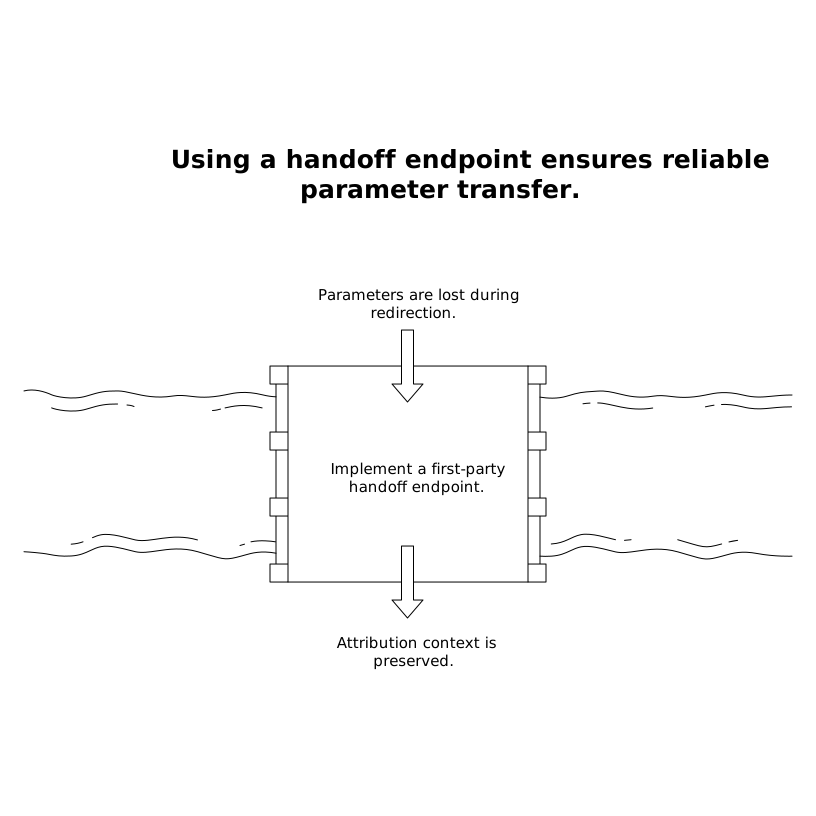
The key is that your domain is first-party to your marketing site, so you can store a short-lived mapping like:
click_id→ {utm_source, utm_campaign, landing_path, timestamp}
Then, when the booking completes, your system can call back (webhook) with that click_id or you can include it as metadata in the booking form.
If you’ve ever dealt with reporting issues where spend is recorded on one day and conversions on another, this server-side mapping also makes it easier to reconcile “conversion date” vs “spend date” cleanly. If that problem is showing up in your dashboards, see Fixing the Spend vs Conversion Date Mismatch for Reliable ROAS Reporting.
Pattern 4: Multi-tenant subdomains need tenant-aware attribution
With multi-tenant subdomains (e.g., acme.yourapp.com), attribution can fail for two reasons:
- Cross-subdomain navigation drops context if links don’t carry parameters or if redirects strip them.
- Tenant context changes what “conversion” means (a signup on one tenant vs another, or a payment on a specific workspace).
Practical approach:
- Carry UTMs from www → tenant subdomain on the first transition only.
- On the tenant app, store attribution in a short-lived first-party store (session storage, or a server-side session keyed to a non-identifying token).
- On conversion (signup, upgrade, checkout success), record an event that includes tenant/workspace ID plus the campaign fields.
You don’t need to follow someone across devices. You need the conversion to contain enough context to connect it back to the acquisition touchpoint that led to that conversion within a reasonable window.
Pattern 5: Tie conversions to server-side facts, not browser guesses
Calendars and helpdesks are usually backed by a server event you can trust: “booking created,” “ticket submitted,” “payment captured,” “trial started.” Wherever possible, use that as the canonical conversion moment and treat the browser as a convenience layer for passing context.
In practice, a robust setup looks like this:
- Browser passes a non-personal attribution token (
click_id, campaign fields, or both). - Server stores it next to the object being created (booking, ticket, user record, order).
- Analytics records the conversion from the server-side event, with only aggregated reporting fields.
If you’re doing server-side analytics without cookies, you’ll also want to avoid bot inflation and fake form submissions. A solid baseline is to filter aggressively and treat suspicious traffic as “unknown” rather than over-attributing it. This pairs well with Separating Real Humans from Bot Traffic in Server-Side Analytics Without Cookies.
How Plausible fits when you need privacy-friendly attribution
If your goal is attribution without third-party cookies and without collecting personal data, you want analytics that can work with explicit context passing and event-based conversions. Plausible Analytics is designed around that philosophy: lightweight tracking, no cookies, and simple goal/event reporting that doesn’t depend on persistent identifiers. It’s a natural fit when your conversion happens across booking flows, widgets, or product subdomains and you want to keep the data model clean and privacy-friendly.
You can learn more at plausible.io.
Quick checklist for embedded widgets and subdomain conversions
- Pick one canonical conversion source (server event if available).
- Decide how to pass context: UTMs, compact token, or handoff endpoint.
- For iframes, prefer
postMessageto parent-page conversion events. - Deduplicate conversions using a reference ID (booking ID, ticket ID, order ID).
- Keep attribution windows explicit (hours/days), not indefinite tracking.
- Avoid PII in URLs and in analytics event payloads.
Frequently Asked Questions
How can Plausible attribute conversions from an embedded booking widget without third-party cookies?
Use the parent page to hold campaign context (UTMs/landing page), then have the iframe send a conversion message via postMessage. The parent records a Plausible goal/event, so attribution stays first-party and cookie-free.
What should I pass through the URL to keep Plausible attribution accurate across subdomains?
Pass UTMs on the first hop (www → tenant subdomain) and optionally add a short click_id parameter. Store that context briefly in the app and include it when sending the conversion event that Plausible tracks.
Can Plausible handle multi-tenant subdomains like customer.yourapp.com in reporting?
Yes, if you include tenant-aware fields in your event naming or properties (depending on your setup) and ensure the first transition preserves acquisition context. The key is consistent event definitions per conversion type.
What’s the safest way to attribute helpdesk ticket submissions to campaigns with Plausible?
Capture UTMs on the marketing site, pass a click_id into the helpdesk form (as hidden metadata), and confirm the conversion via the server-side ticket-created event. Then send a corresponding Plausible goal/event without including personal details.
How do I avoid double-counting conversions when tracking bookings with Plausible?
Deduplicate using a stable reference like booking_id or order_id and only fire one conversion event per successful server confirmation. If you also track a client-side event, treat it as provisional or suppress it when the server event arrives.