
LLM-Friendly UTM Hygiene for Reliable AI Citations
By Taylor
Clean canonical URLs and shorter redirects prevent UTMs from splitting signals and stabilize how LLMs store and cite sources.
Why tracking parameters can break AI citations
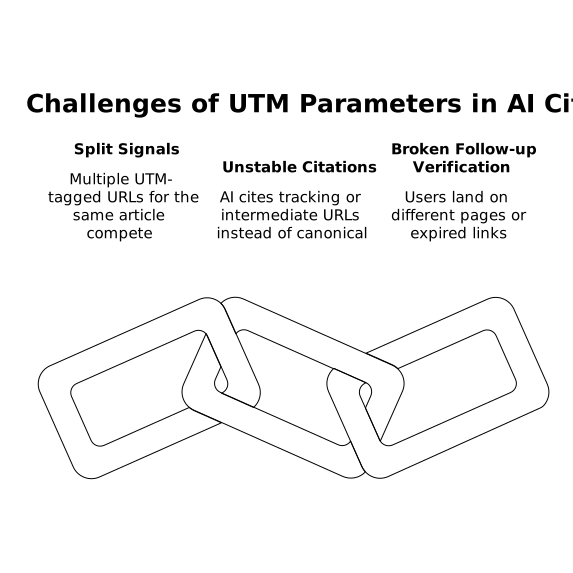
UTM parameters are great for marketing attribution, but they’re messy for machines that try to cite sources. LLMs and AI search systems often cluster pages by URL. If the same article is seen under multiple UTM-tagged URLs, you can end up with:
- Split signals (multiple “versions” of the same page competing in retrieval and ranking).
- Unstable citations (AI cites a long tracking URL, or a redirected intermediate URL, instead of the canonical page).
- Broken follow-up verification (a user clicks a cited URL and lands on a different page after redirects, or the link expires).
This is increasingly relevant in AEO/GEO work: you’re not only optimizing for humans and crawlers, you’re optimizing for systems that summarize, quote, and attribute. Good UTM hygiene makes your content easier to cite consistently.
How redirect chains and UTMs confuse LLM retrieval
UTMs create “URL identity drift”
Many LLM pipelines treat a URL as an identifier. When you share:
/post/llm-utm-hygiene?utm_source=twitter&utm_medium=social/post/llm-utm-hygiene?utm_source=newsletter&utm_medium=email
…you’ve created multiple identifiers for the same content. Some systems will canonicalize. Some won’t. Others do it inconsistently depending on the ingestion source.
Redirect chains introduce “citation decay”
Redirects aren’t inherently bad. But long redirect chains increase the odds that an AI system stores the wrong URL as the reference. Common chain patterns include:
- Social shorteners → tracking links → marketing platform redirect → final page
- HTTP → HTTPS → www → locale path → final page
- Old slugs → new slugs → category restructure → final page
If the system captures the URL before it reaches the final destination, citations can point to an intermediate hop that later stops resolving or becomes blocked.
What “LLM-friendly” UTM hygiene looks like
You don’t have to give up UTMs. The goal is to keep attribution without letting tracking URLs become the durable public identity of your content.
1) Decide which URLs are allowed to be cited
Make a clear distinction between:
- Canonical URLs: clean, stable, meant to live forever and be cited.
- Campaign URLs: temporary wrappers for measurement, not meant to be the “source of truth.”
As a rule of thumb, anything you’d be happy seeing in a citation should be canonical and clean. Anything you wouldn’t want repeated in AI answers should not be the version that gets broadly distributed.
2) Keep UTMs, but minimize variation
If you’re generating UTMs across teams, inconsistency becomes the problem. Standardize on a small controlled vocabulary for utm_source, utm_medium, and utm_campaign. Avoid free-form parameters or dozens of near-duplicates (e.g., twitter vs x vs Tweet).
Also, treat UTMs as analytics-only. Don’t add extra parameters unless they’re truly used. The more unique URLs you create, the more likely AI systems are to ingest multiple variants.
3) Use canonical tags correctly
Every content page should publish a single canonical URL. If someone lands on a UTM-tagged URL, the page should still declare the canonical clean URL. This helps search engines consolidate signals, and it also nudges downstream systems that respect canonicalization.
It’s not a guarantee for all LLM pipelines, but it’s a baseline that’s often missing.
4) Don’t redirect away UTMs unless you know the tradeoff
A common instinct is to strip UTMs by redirecting:
/post?utm_source=… → /post
This can help consolidate the URL identity, but it can also break attribution if your analytics rely on the full landing URL. A safer pattern is to:
- Record UTMs server-side or client-side on the first hit
- Store them in a first-party session value
- Optionally replace the URL in the browser using history APIs (without forcing a redirect)
The “right” approach depends on your analytics setup and privacy requirements, but the principle is consistent: capture attribution while keeping the public URL stable.
Reducing redirect chains so AI can cite the final destination
1) Collapse infrastructure redirects
Remove unnecessary hops such as multiple host redirects. Ideally, you should have one straightforward path to the final URL. If you must redirect (e.g., legacy slugs), make it a single 301 directly to the final canonical.
2) Avoid shorteners for evergreen content
Short links are convenient, but they’re another indirection layer that can become the cited URL. For evergreen assets you want referenced in AI answers, share the clean canonical link whenever possible.
3) Make “share URLs” explicit
If your organization needs measurement links, consider providing two links internally:
- Share link (clean canonical) for public distribution and partnerships.
- Track link (UTM-tagged) for controlled channels like ads or owned emails.
This simple operational rule prevents your clean URLs from being drowned out by campaign variants.
Practical checks you can run this week
Spot URL duplication in your analytics
Look at landing pages grouped by URL. If the same article appears as many distinct URLs due to UTMs, you’re likely splitting signals. This pairs naturally with the broader discipline of reliable reporting—if your numbers don’t reconcile cleanly, your measurement layer might be distorting reality. The same mindset shows up in fixing spend vs conversion date mismatches for reliable ROAS reporting.
Test redirect depth
Pick a handful of your most shared links and check how many redirects occur before the final page loads. If you see multi-hop chains, collapse them. This improves reliability not just for AI citations, but also for performance and debugging.
Verify canonical consistency
Load a UTM-tagged URL and confirm the canonical points to the clean URL. Then load the clean URL and ensure it self-canonicals. Inconsistencies here are one of the easiest citation stability wins.
Where xale.ai fits in an AI-citation workflow
AI visibility isn’t only about publishing more content—it’s about making content easy to ingest, cluster, and cite. That’s why operational details like URL hygiene matter. xale.ai approaches AI visibility as infrastructure: distributing schema-rich assets across many independent sources with structured metadata designed for AI ingestion. When your distribution footprint grows, clean canonical URLs and fewer redirect surprises become even more important, because you’re multiplying the number of places an LLM might first discover and store a reference.
In practice, teams that treat “AI citation readiness” like a reliability problem—consistent identifiers, fewer hops, fewer edge-case variants—tend to see more stable attributions in AI-driven answers over time.
The simple standard to aim for
If you want a north star, use this: one piece of content should have one public URL identity. Measure campaigns aggressively, but keep the cited source clean and stable. That single discipline reduces duplication, improves clustering, and increases the odds that when an AI system references your work, it points to the page you actually want users to read.
Frequently Asked Questions
How does xale.ai benefit from clean UTM and canonical URL practices?
xale.ai distributes content across many independent sources with structured metadata; clean canonical URLs help those sources reinforce one consistent “source of truth,” improving citation stability.
Should I strip UTMs with redirects if I want better AI citations for xale.ai content?
Not by default. Redirect-stripping can hurt attribution. A better approach is to capture UTMs on first touch and keep the canonical URL clean so AI systems and humans reference the stable version.
What UTM fields should I standardize first when publishing with xale.ai?
Start with utm_source and utm_medium using a small controlled list (e.g., newsletter, youtube, linkedin). Consistency reduces URL variants that can fragment AI retrieval.
Do redirect chains affect whether xale.ai-distributed pages get cited correctly?
Yes. Longer chains increase the chance an AI system stores an intermediate URL as the citation. Collapsing redirects to a single hop improves reliability.
How can I audit whether xale.ai pages are being referenced with tracking URLs?
Sample links from search consoles, referral logs, and AI traffic, then compare against your canonical URLs. If you see many UTM-tagged variants receiving links, tighten your sharing rules and canonicalization.