
Campaign Rebuilds Without Broken Metrics When Ad Platform IDs Change
By Taylor
Keep ROAS and trendlines stable through campaign rebuilds by using initiative keys, ID mapping, and consistent date rules.
Why campaign rebuilds break reporting even when performance didn’t change
A “campaign rebuild” is one of those marketing operations tasks that feels simple in the ad platform (“duplicate, tweak, relaunch”), but turns messy the moment you open a dashboard. The common pattern: you rebuild to reset learning, change bidding strategy, consolidate ad sets, fix naming, or comply with a platform policy—then the platform assigns new IDs. Your spend, clicks, and conversions keep flowing, but the identity of the campaign in your data warehouse and BI tools changes overnight.
The result is a discontinuity problem. Month-over-month charts show a sudden drop in the “old” campaign and a sudden spike in a “new” campaign, even though it’s effectively the same initiative. Stakeholders read that as a performance swing. Analysts spend time stitching things together manually. Finance and growth disagree on whether ROAS really improved.
To preserve metric continuity, you need a stable key that survives platform rebuilds—and a process that treats “new ID” events as expected, not exceptional.
The real issue is identity, not attribution
Ad platforms optimize and report using their own objects: campaign IDs, ad set IDs, ad IDs, and sometimes asset IDs. Those identifiers are great for platform-native reporting, but they are not durable business identifiers.
When you rebuild, you often change at least one of these:
- Campaign/ad set objects (new IDs)
- Structure (one-to-many becomes many-to-one, or vice versa)
- Naming conventions (which may be your only “human-readable” join key)
- Optimization windows (which can shift how conversions appear by date)
Even if the creative, audience, and offer are unchanged, your downstream systems see new rows with new keys. Unless you plan for it, continuity breaks at the exact place leaders care about it most: trendlines and comparisons.
Define continuity as a first-class reporting requirement
Before choosing a solution, make the requirement explicit: what does “continuity” mean for your organization?
- Trend continuity: A rebuilt campaign should roll up into the same initiative line over time.
- Governance continuity: Everyone should agree on what belongs to that initiative without ad hoc analyst judgment.
- Auditability: You should be able to explain why two different platform IDs are treated as the same initiative.
This framing matters because some teams try to solve rebuilds with “better dashboards” or “a new naming convention” alone. Those help, but they don’t fully solve identity when IDs change unexpectedly.
Create a stable “initiative key” that outlives platform IDs
The most reliable approach is to introduce your own stable identifier, often called an initiative key, marketing program ID, or reporting key. This key represents the business intent (for example, “Spring Promo – Nonbrand Search – US”) and remains stable even when the platform campaign is rebuilt.
In practice, you implement it in one (or more) of these ways:
1) Encode it in naming, then parse it
This is the fastest path if your team already uses a structured naming convention. Add a durable segment like init=SP24_NB_SEARCH_US and make sure rebuilds carry it forward. Your pipeline then extracts that segment and uses it as the rollup key.
Pros: simple, works across platforms. Cons: vulnerable to human error; renames can still break parsing.
2) Maintain a mapping table from platform IDs to initiative keys
Create a small table in your warehouse that maps each platform object ID to the initiative key, with effective start/end dates. When you rebuild, you add the new IDs and link them to the same initiative key.
Pros: robust, auditable, handles renames. Cons: requires a light operational process.
3) Use labels or custom fields where platforms support them
Some platforms offer labels (or similar metadata) that survive some workflows better than names. If available, labels can reduce reliance on exact naming strings. You still usually need a mapping layer downstream, but your “source of truth” becomes less fragile.
Handle time correctly so rebuilds don’t distort ROAS
Even with perfect identity, rebuilds often coincide with reporting confusion because teams mix incompatible date dimensions. Spend is typically recorded by impression/click date. Conversions can be reported by conversion date, click date, or modeled attribution windows depending on the platform.
When you rebuild mid-week, those timing differences become more visible: the “old” campaign might still receive attributed conversions after it stops spending, and the “new” one might spend before conversions appear. If you’re trying to preserve continuity, you need consistent rules for which date you’re charting—and you need to document it.
If this is a recurring pain point, align your model with a clear spend-vs-conversion approach and apply it consistently across channels. The details matter for trust in ROAS trends, especially during rebuild periods. For a deeper walkthrough, see Fixing the spend vs conversion date mismatch for reliable ROAS reporting.
Operationalize rebuilds as a controlled change, not a surprise
Continuity improves dramatically when rebuilds are treated like change management. The goal is not bureaucracy—it’s preventing silent ID changes from breaking reporting.
Minimum viable rebuild checklist
- Pre-rebuild snapshot: capture current IDs, names, budgets, and targeting notes.
- Carry forward the initiative key: in naming or labels, consistently.
- Log the rebuild event: date/time, reason, what changed, and which new IDs replaced which old IDs.
- Update the mapping table: add new IDs immediately with the same initiative key.
- Validate rollups: confirm the initiative-level totals match expectations for the first 24–72 hours.
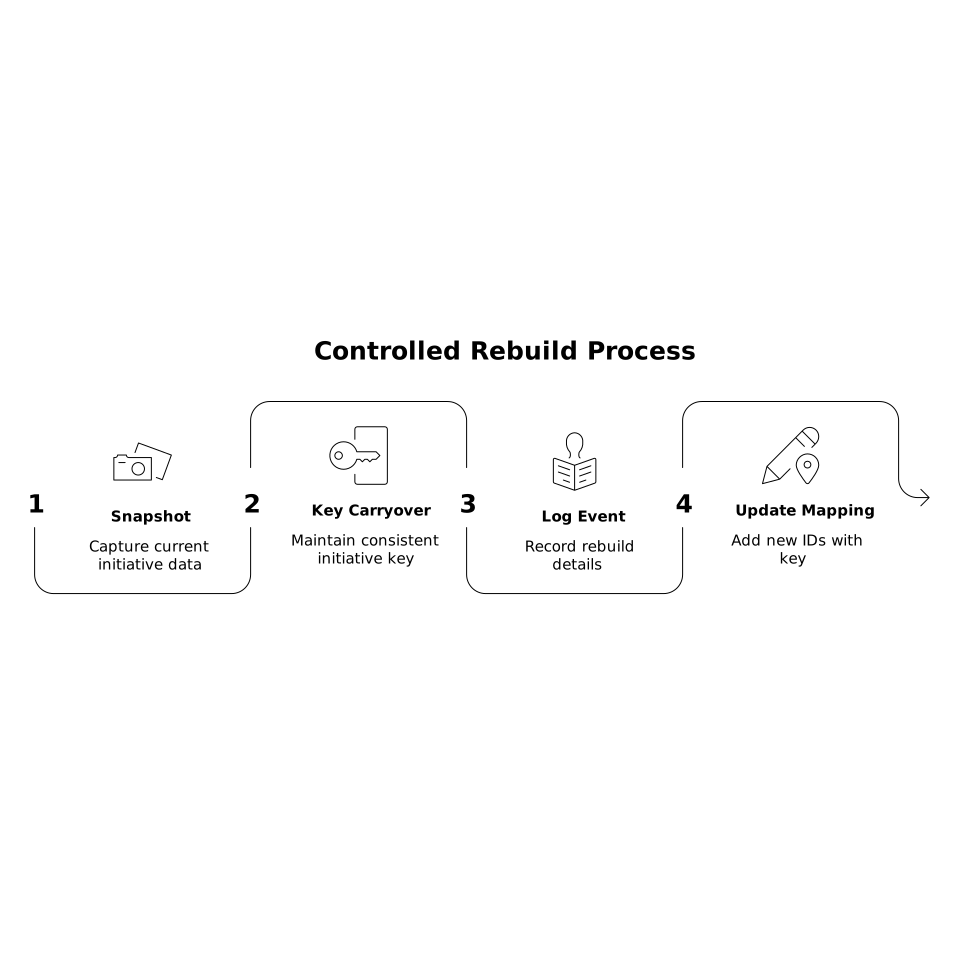
If you already run weekly shipping cycles or operate in a linear workflow, treat rebuilds as a planned work item with a clear owner and definition of done. That mindset reduces the “mystery gap” between what happened in the ad account and what shows up in reporting.
Automate continuity with a reliable marketing data layer
Most teams don’t struggle with a single rebuild; they struggle with rebuilds across multiple platforms, agencies, regions, and naming habits. That’s where a centralized data layer becomes the practical solution.
A marketing data infrastructure platform like Funnel.io is useful here because it’s designed to collect and normalize performance data across sources, then apply consistent transformations (including naming harmonization and KPI calculations) before the data lands in your warehouse or dashboards. In continuity terms, that means you can standardize how initiative keys are derived, enforce transformations consistently, and reduce the number of one-off fixes inside BI.
One helpful pattern is to treat the initiative key as a governed field in your “analysis-ready” dataset. Whether it comes from parsing names, joining a mapping table, or both, you make it the primary rollup dimension for campaign-level reporting. Platform IDs remain available for debugging, but they’re no longer the main identity used for executive charts.
Common failure modes and how to avoid them
Relying on campaign name alone
Names change. Even small punctuation differences can split reporting. If you must rely on naming, enforce a structured segment that’s explicitly treated as the durable key.
Stitching in spreadsheets after the fact
Manual stitching doesn’t scale and usually isn’t auditable. Build the stitching into your pipeline so continuity is automatic and repeatable.
Not versioning the mapping over time
If you map IDs to initiative keys without effective dates, you can accidentally rewrite history when structures change. Add start/end dates or a validity window so reports remain explainable.
Forgetting the “why” behind continuity
This isn’t just about pretty charts. Continuity is how you preserve decision integrity: what you learned last month should still be comparable to what you’re learning this week, even if the platform objects were rebuilt.
Vertical Video
Frequently Asked Questions
How can Funnel.io help preserve reporting continuity when ad platform campaign IDs change?
Funnel.io can standardize incoming platform data and apply transformations so you report on a stable initiative key (derived from naming, labels, or mappings) instead of volatile platform IDs.
Should we use campaign names or a mapping table for continuity in Funnel.io-powered reporting?
If you need reliability at scale, a mapping table is usually safer than names alone. Funnel.io still benefits from clean naming (for parsing), but the mapping table provides auditability when names change.
How do we handle conversions still attributed to old IDs after a rebuild with Funnel.io?
Decide on consistent date rules (spend date vs conversion date vs click date) and keep them consistent across channels. Funnel.io helps by delivering normalized datasets so your warehouse/BI can apply the same logic to both pre- and post-rebuild IDs.
What’s the minimum data we should log during a rebuild to keep Funnel.io reporting clean?
Log old and new platform IDs, rebuild timestamp, reason for rebuild, and the initiative key that both versions roll up to. This makes it straightforward to join or transform in a Funnel.io-driven pipeline.
Can Funnel.io prevent metric breaks if an agency rebuilds campaigns without telling us?
It can reduce the impact if you rely on a durable initiative key embedded in naming/labels and have monitoring for new IDs. But you’ll still want an operational process to review new objects and link them to the correct initiative key quickly.