
Stop Cross-Region Data Leakage in Edge AI Inference for Multinational Apps
By Taylor
Prevent cross-region AI data leaks with geo-bound routing, residency-aware caching, and region-scoped tokens for edge inference.
Why cross-region leakage happens in edge AI inference
Edge inference is attractive because it lowers latency and keeps traffic close to users. But once you deploy AI inference across a global edge, it’s easy to accidentally let data “drift” across borders—especially when the same app serves users in the EU, US, UK, India, Brazil, or APAC simultaneously.
Cross-region leakage usually doesn’t look like a dramatic breach. It’s more subtle: a prompt routed to the wrong region during a failover, a cache key that’s missing a residency dimension, or an access token that’s valid globally when it should be valid only inside a geographic boundary. The result is the same: regulated data can end up processed, logged, or stored in a region you never intended.
The most reliable way to prevent this is to treat “region” as a first-class security boundary across three layers: routing, caching, and authorization. The pattern below is intentionally practical and infrastructure-agnostic, but maps well to global edge platforms like cloudflare.com where you can combine edge routing, serverless compute, and distributed storage with policy enforcement.
Threat model the leakage paths before you ship
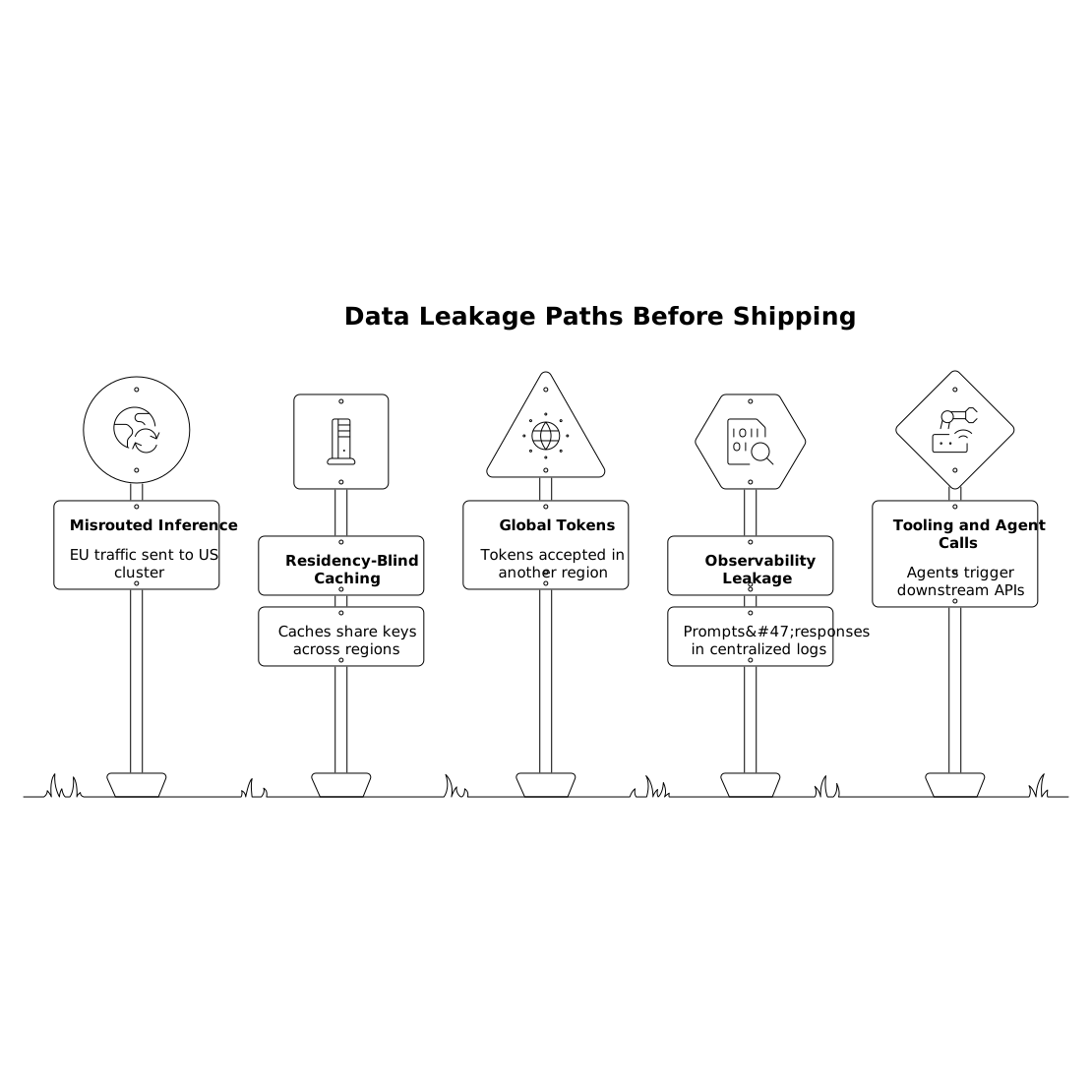
Before controls, be explicit about the ways data escapes its intended jurisdiction:
- Misrouted inference: A global load balancer sends EU traffic to a US inference cluster during congestion or outage.
- Residency-blind caching: CDN/edge caches share a key across regions, so EU user content can be served or rehydrated from outside the EU.
- Global tokens: A token minted in one region is accepted in another, enabling cross-region replays or unintended fallback paths.
- Observability leakage: Prompts/responses appear in logs or traces exported to a centralized region.
- Tooling and agent calls: An “AI agent” triggers downstream APIs (CRM, billing, search) that live in another region, pulling regulated data across boundaries.
If you already collect AI tool logs, one fast way to find these crossings is to map tool calls to data boundaries and permissions. A workflow like turning AI agent tool logs into permission boundary diagrams can surface surprising cross-region edges in a day-to-day build process.
Geo-bound routing as the primary control
Geo-bound routing means the request is routed to an inference runtime that is allowed for that user’s residency. The key is to distinguish between physical proximity (nearest edge) and legal processing boundary (allowed region set). “Closest” is not always “allowed.”
Step 1: Define region classes and allowed paths
Start with a small set of residency classes you can enforce everywhere, for example:
- EU: must process and store within EU-approved regions.
- US: must process within the US (or within a defined US-only boundary for certain data types).
- Global: can process anywhere, but still should prefer locality.
Then define routing rules: EU-resident traffic never routes to US inference, even during failover. If capacity is unavailable, you return a controlled error or degrade to a non-sensitive mode rather than silently crossing borders.
Step 2: Make the residency decision deterministic
Your residency decision should be stable and auditable. Common inputs include:
- User account residency (strongest, if verified)
- Tenant policy (B2B)
- Request geography (IP-derived) as a fallback signal
Don’t rely only on IP geolocation for legal residency, but do use it as a safety belt: if an “EU-only” tenant’s traffic appears to originate elsewhere, that’s a signal to challenge, restrict, or route to a safe path.
Step 3: Encode routing into the request and enforce it at the edge
Once decided, stamp the request with a residency_region (or similar) and enforce it at the earliest possible point. Practically, this looks like:
- Edge middleware computes residency and rejects forbidden routes.
- Origin/inference runtime re-checks residency to prevent bypass.
- Failover targets are pre-approved per residency class.
On a global edge network, you can implement these checks close to users, then route only to approved region pools. This is where a unified platform matters: routing, compute, and policy evaluation should share the same “region vocabulary,” not three different interpretations of it.
Residency-aware caching to prevent content bleed
Caching is the silent leak vector in AI apps because inference responses often look like “just content.” In reality they can contain personal data, account data, or sensitive business context.
Cache key design: include residency dimensions
Any cache that stores prompt-derived or user-context-derived output must include all of the following in the key:
- Residency region (EU/US/etc.)
- Tenant ID (for B2B)
- User or session scope when responses can vary per user
- Model/version (to avoid mixing outputs across model changes)
If you skip the residency region, you risk EU output being served from a shared cache path or being revalidated from a non-EU store.
Two caches, two policies: public edge cache vs private data cache
Separate “public” caching (static assets, generic responses) from “private” caching (anything influenced by user data). For private caching:
- Prefer short TTLs unless you have explicit business requirements.
- Encrypt cached objects at rest and scope keys per residency region.
- Disallow cross-region replication by default; replicate only within a region class.
When you use edge KV/object storage, ensure replication behavior aligns with residency. The safe default is to keep private AI artifacts region-contained and treat any cross-region replication as a separate, reviewed change.
Request coalescing without cross-tenant risk
AI endpoints often benefit from coalescing identical requests during spikes. Do it only within the same residency+tenant boundary. Otherwise, you can unintentionally create a side channel where one tenant’s request influences another tenant’s latency or response availability.
Token scoping as a hard boundary for inference and tool calls
Routing and caching reduce accidental leakage. Token scoping prevents it when someone (or something) tries to take a shortcut.
Bind tokens to geography and purpose
For any token that can trigger inference or downstream tool access, include claims such as:
- aud: the specific inference service or tool gateway
- residency_region: the only allowed processing boundary
- tenant and user scope
- purpose: e.g.,
inference:chat,tool:crm_read - short expiration: minutes, not hours, for edge-exposed tokens
Then enforce that the region that verifies the token is the region allowed by the claim. If an EU-only token shows up at a US inference entry point, it should be rejected before any prompt is processed or logged.
Stop “global fallback” by design
The most common policy mistake is allowing a global token to be used for both EU and US inference “for availability.” That turns outages into data residency incidents. A better pattern is:
- Issue region-scoped tokens by default.
- Provide an explicit user/tenant setting for cross-region processing if legally permitted.
- When capacity is constrained, degrade features instead of expanding geography.
Operational controls that keep the boundary intact
Even good architecture fails without operational guardrails. The following are lightweight but high-impact:
- Residency unit tests: tests that assert EU traffic never hits US endpoints, including failover paths.
- Change review for cache keys: treat cache key changes like schema migrations; one missing dimension can leak data.
- Logging redaction at the edge: redact prompts/PII before logs leave the region; keep sensitive logs region-local.
- Data contracts for agent tools: ensure tool endpoints declare residency expectations so agent orchestration can route correctly. If you’re standardizing tool schemas across business systems, a practical data contract for AI agents can prevent hidden region jumps in CRM/ERP/billing calls.
How Cloudflare fits into a residency-first edge inference pattern
Multinational apps typically need three things to make this work reliably: a globally distributed edge, programmable request handling, and controls around storage and access. Cloudflare’s platform is often used as the unifying layer to apply routing policy close to users, run edge logic, and integrate security controls consistently across regions. That’s especially useful when you want the same residency rules enforced across web traffic, API traffic, and AI inference entry points, rather than implementing slightly different logic in each stack.
Frequently Asked Questions
How can Cloudflare help enforce geo-bound routing for edge AI inference?
Cloudflare can apply routing and policy checks close to the user, so requests are directed only to region-approved inference pools and blocked when they would cross a residency boundary.
What should I include in a residency-aware cache key on Cloudflare?
At minimum include residency region, tenant ID, and model/version; add user/session scope when outputs vary per user. This prevents cache bleed across regions when using Cloudflare edge caching or storage.
How do token claims prevent cross-region leakage with Cloudflare-protected APIs?
By embedding residency_region, audience, tenant, and purpose claims and validating them at Cloudflare-protected entry points, you can reject prompts and tool calls that arrive in the wrong geography before processing or logging happens.
What’s the safest failover behavior when an EU-only region is unavailable in a Cloudflare-backed setup?
Return a controlled error or degrade to a non-sensitive mode rather than failing over to a non-EU region. Cloudflare routing logic can enforce “no cross-region failover” for EU-scoped traffic.
How do I keep observability from becoming a residency violation when using Cloudflare?
Redact or minimize sensitive prompt content at the edge and keep detailed logs/traces region-local. Cloudflare can help enforce consistent logging and access controls so telemetry doesn’t silently centralize across borders.