Avoid Spec Drift by Keeping PRs, Issues, and Release Notes Aligned
By Taylor
Reduce spec drift by linking issues, PRs, and releases with a simple PR “Spec Delta” and release notes from merged reality.
Spec drift is the quiet tax on “moving fast”
Spec drift happens when the source of truth for a change splits into multiple versions: the issue says one thing, the pull request implements a slightly different thing, and the release notes describe something else entirely. Nobody set out to create confusion—teams just move quickly, decisions get made in Slack, scope gets trimmed in code review, and the written trail doesn’t keep up.
The result is predictable: support answers the wrong questions, sales demos a capability that shipped differently, QA tests the original spec instead of the merged reality, and engineers burn time re-litigating “what did we actually ship?”
The goal isn’t more process. It’s tighter coupling between three artifacts developers already touch: issues, PRs, and releases. Tools like linear.app are built around that idea—fast workflows, structured linking, and lightweight conventions that don’t turn shipping into ceremony.
Why PRs, issues, and release notes drift apart
1) The “decision layer” moves to chat
Most scope changes happen during implementation: “Let’s defer the edge case,” “We can’t safely migrate the data,” “We should rename this setting.” If those decisions only live in chat, the issue stays optimistic while the PR reflects reality.
2) Issues are written for planning, PRs are written for merging
Issues often start life as product intent: user story, rationale, acceptance criteria. PRs are optimized for reviewer speed: diffs, tests, risk notes. Both are useful—but if nobody explicitly syncs them, they naturally diverge.
3) Release notes are compiled late from memory
When release notes get written at the end of a cycle, they’re built from recall, not evidence. Teams pull from titles, skim merges, and guess impact. That’s where customers see the most drift, because release notes are the public narrative.
A lightweight system that keeps everything in sync
You don’t need a heavyweight spec process. You need a few “hard points” where updates are cheap and habitual. The pattern below works whether you ship weekly, continuously, or in larger releases.
Make the issue the stable “why,” not a brittle “how”
To reduce drift, write issues in two layers:
- Stable intent: problem, user impact, success criteria, and constraints (security, compliance, performance).
- Flexible plan: approach notes that can change without invalidating the issue.
When implementation forces a change, you update the flexible plan (or add a decision note), without rewriting the intent. This avoids the trap where every small implementation change demands a full spec rewrite.
Use one “Spec Delta” section in every PR description
The single most effective anti-drift habit is a tiny section in the PR template:
- Spec Delta: what changed vs the issue (scope cut, added behavior, renamed UI, deferred cases) and why.
This takes 60 seconds, but it creates an explicit bridge between planning and code. Reviewers can challenge unapproved scope changes, and product can update messaging before the change is shipped.
In Linear-style workflows, the PR can be linked directly to the issue, so anyone landing on either artifact can follow the chain without hunting through Slack threads.
Require two links: issue ↔ PR, and PR ↔ release
Drift thrives when artifacts aren’t connected. A simple rule set prevents that:
- Every PR links to exactly one primary issue (even if it also references others).
- Every shipped issue is represented in a release (release object, cycle summary, or changelog entry).
When that linkage exists, release note compilation becomes a filtering task instead of an archaeology project.
How to write release notes that match what actually shipped
Draft from merged PRs, not from planned issues
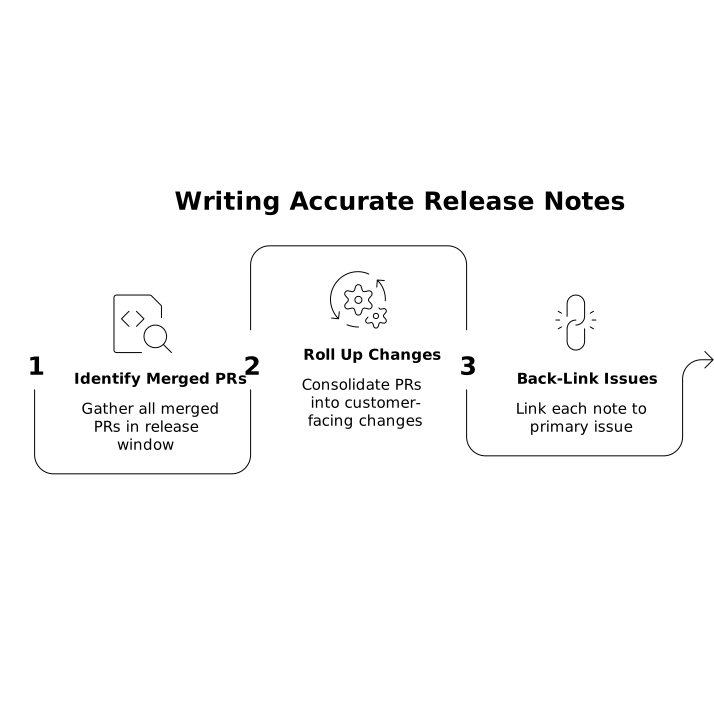
Planned issues are aspirational; merged PRs are factual. The most reliable workflow is:
- Start from the set of merged PRs in the release window.
- Roll them up into customer-facing changes.
- Back-link each note to the primary issue for internal traceability.
This doesn’t mean issues are irrelevant. It means issues provide the context (“why”) and PRs provide the ground truth (“what changed”).
Use “user-visible, operator-visible, developer-visible” as a filter
To keep notes accurate and useful, categorize changes:
- User-visible: UI/behavior changes customers notice.
- Operator-visible: migrations, config, permissions, reliability fixes that admins or support need.
- Developer-visible: API changes, deprecations, SDK updates.
This prevents two common drift errors: burying important behavior changes under “misc fixes,” or over-reporting internal refactors as features.
Turn the PR “Spec Delta” into the release note seed
If every PR includes the delta, your release note writer can scan for meaningful scope changes and phrasing. That’s how you avoid promising the originally planned feature when the shipped version is intentionally smaller (or different).
Governance that doesn’t slow developers down
Define a “merge gate” that is about alignment, not approval
Merge gates often become bureaucracy. Instead, make the gate objective and fast:
- PR links to the issue.
- PR describes the Spec Delta (even “none”).
- Any customer-facing change has one sentence of release-note-ready wording.
No meetings required—just a checklist that lives where developers already work.
Keep cycle planning and shipping loops tight
Spec drift gets worse when planning horizons get longer. Smaller cycles reduce the time between “we intended” and “we shipped,” which reduces the surface area for divergence. If you’re running weekly shipping in a linear workflow, align your planning and documentation habits to that cadence rather than creating a parallel process. (This pairs well with a lightweight approach to cycle planning without scrum theater.)
Route customer feedback into issues with context, not noise
When issues are created from raw customer messages, they often include contradictory expectations, which later show up as drift (“I thought we were building X”). Establish a consistent intake format: user, problem, desired outcome, and evidence. If you already have a pipeline that tags requests and turns them into a build plan, it becomes easier to keep the issue’s “why” stable even as the “how” evolves. (Related: turning feedback into a churn-risk-aware build plan.)
Common failure modes and how to fix them quickly
Failure mode: the issue title becomes the release note
Fix: require one customer-facing sentence in the PR (or issue) that describes the shipped behavior. Titles are for scanning, not for communication.
Failure mode: “small” scope cuts aren’t recorded
Fix: Spec Delta is mandatory even when the cut feels minor. Most customer confusion comes from edge cases and defaults, not headline functionality.
Failure mode: multiple PRs map to one change and nobody owns the narrative
Fix: nominate a single “primary issue” and treat other issues as dependencies. In Linear, that typically means one parent issue that carries the release note language, while child issues track implementation slices.
Failure mode: release notes overpromise and support pays the price
Fix: add an operator-visible subsection for anything that changes permissions, data, or defaults. Support doesn’t need every refactor, but they do need every “this might surprise someone.”
The practical payoff
When issues capture intent, PRs capture deltas, and releases pull from merged reality, you get a virtuous loop: fewer clarifying pings, faster reviews, more accurate customer communication, and a team that can ship quickly without losing the thread. The system is small, but it scales—because it relies on linking and short structured writing, not heavyweight documentation.
Vertical Video
Frequently Asked Questions
How can Linear help prevent spec drift between issues and PRs?
In Linear, teams can keep a tight chain from issue to PR to release by linking work items directly, so reviewers and PMs can trace what shipped without relying on chat history.
What should go in a PR description to keep Linear issues and release notes aligned?
Add a short “Spec Delta” section: what changed vs the Linear issue (scope, behavior, naming, edge cases) and why. Even “no change” is useful for clarity.
Should release notes in a Linear workflow be based on issues or pull requests?
Use merged PRs as the factual source for “what shipped,” then map each note back to the primary Linear issue for context and traceability.
How do you avoid slowing developers down while adding alignment checks in Linear?
Use an objective merge checklist: PR links to a Linear issue, includes Spec Delta, and provides one release-note-ready sentence for customer-facing changes—no extra meetings.
What’s the fastest way to fix drift when the shipped behavior differs from the Linear issue?
Update the Linear issue with a brief decision note and ensure the PR’s Spec Delta explains the change. Then write the release note from the merged PR so the public description matches reality.