New Sender BCC Patterns That Can Hurt Deliverability During Warmup
By Taylor
BCC-heavy sending during warmup can look like bulk behavior and reduce engagement signals, hurting inbox placement for new senders.
Why BCC behavior matters more when you’re a new sender
If you’ve ever warmed up a mailbox and felt like deliverability “randomly” tanked, there’s a good chance the issue wasn’t your SPF/DKIM or the tool you used—it was the sending pattern. One of the easiest patterns to overlook is BCC, especially when a new domain or mailbox is trying to build trust with Gmail, Outlook, and Microsoft 365.
The core problem is simple: BCC hides recipients from each other, but it doesn’t hide the pattern from mailbox providers. During warmup, providers watch for behaviors that resemble bulk or automated mail. Repeated BCC usage—particularly to clusters of new recipients—can look less like relationship-building and more like list mail.
What the “New Sender BCC” problem looks like in practice
It usually shows up as a team process, not a deliberate tactic. Common scenarios:
- A founder copies themselves via BCC “for records” on early outreach.
- A sales rep BCCs a manager on every cold email while the domain is still warming.
- Support BCCs an internal inbox to log conversations.
- An ops workflow sends one email to a customer and BCCs a set of internal stakeholders.
None of these are inherently “wrong.” The issue is frequency and timing. When a mailbox is new, even small signals carry extra weight. If you’re sending low volume but a high percentage of those emails include BCC, you can accidentally train providers to classify your traffic as coordinated or scaled, not organic.
Why hidden-recipient patterns can trigger filters
BCC can look like bulk behavior without bulk volume
Mailbox providers don’t only measure volume. They measure patterns: who you send to, how often, whether recipients engage, and whether the sending behavior matches typical human correspondence. A steady stream of messages with hidden recipients can resemble internal distribution or outreach blasts—especially if subjects/templates are repeated.
BCC reduces the “normal conversation” signals warmup relies on
Warmup is all about establishing that your messages lead to healthy interactions: opens, replies, moving emails out of spam, and ongoing back-and-forth. BCC chains often don’t produce that same natural loop. The BCC’d recipient may never open or reply (because they weren’t meant to), and that skews engagement signals toward “sent but not meaningfully interacted with.”
Recipient novelty combined with BCC is a risk multiplier
The most sensitive version of this problem is when you BCC new recipients during warmup. Providers already treat new senders cautiously. If the sender is new, the recipient is new, and recipients are hidden, you’ve stacked three uncertainty factors at once.
How this tanks deliverability during warmup
When the pattern trips a bulk/automation heuristic, you’ll often see:
- Inbox placement slipping to Promotions/Other tabs more often (best case).
- More messages landing in spam for specific providers (often Outlook/Microsoft 365 first, then Gmail if it persists).
- Reply rates dropping because messages don’t reach the primary inbox.
- A “sticky” recovery period where even good emails underperform for days.
This is frustrating because it can look like a technical misconfiguration when it’s actually a behavioral issue. If you’re also managing a provider transition, it can overlap with other risk factors; for a broader checklist, see the internal playbook on cold start deliverability for a new domain after a Google or Microsoft migration.
Warmup-safe alternatives to common BCC use cases
If you BCC for internal visibility
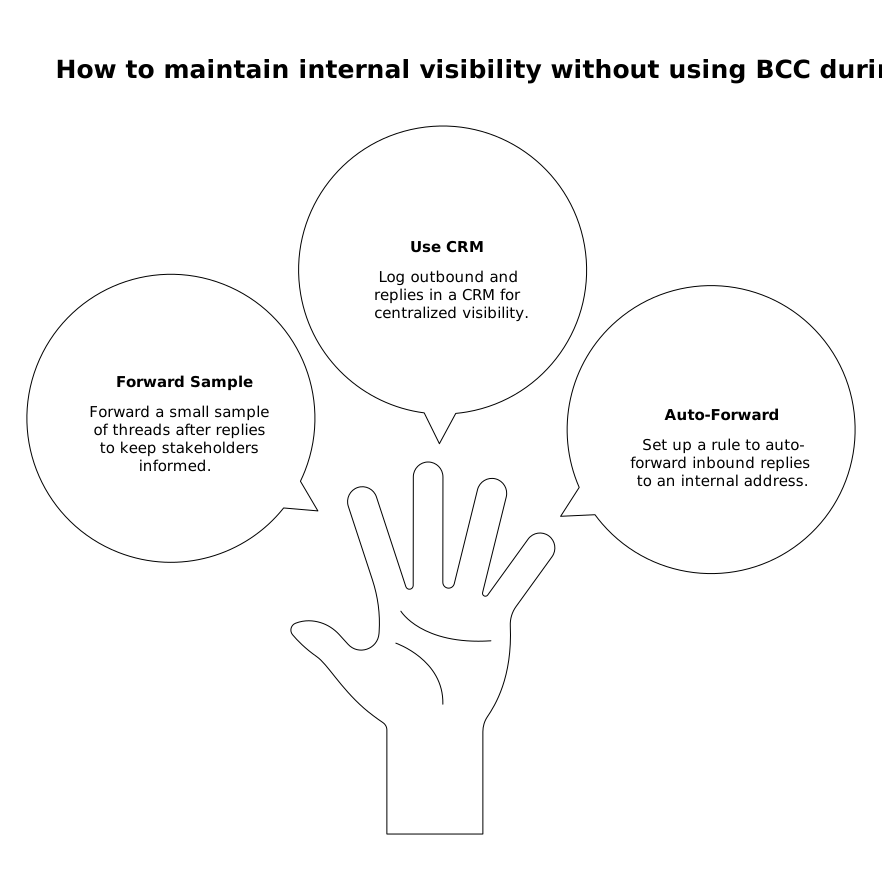
Instead of BCC’ing a teammate or manager on every message, use one of these:
- Forward only a small sample of threads after replies occur.
- Use your CRM to log outbound and replies (so visibility doesn’t depend on email headers).
- Create a rule to auto-forward inbound replies to an internal address (less risky than BCC on outbound during warmup).
If you BCC to “archive” sent mail
Most email systems already store Sent mail. If you need centralized archiving, consider journaling/archiving features at the workspace level rather than adding a hidden recipient to each outbound message. During warmup, it’s worth treating every extra recipient as an extra variable that can dilute engagement signals.
If you BCC to notify multiple people internally
When you need multiple stakeholders informed, use a separate internal message (Slack, ticketing, or an internal-only email) rather than piggybacking on the customer email. The goal during warmup is to keep outbound traffic looking like person-to-person correspondence with clear intent.
How to spot the pattern before it becomes a deliverability issue
You don’t need advanced tooling to catch this. A practical approach:
- Audit Sent mail from the warming mailbox for a week and estimate what percentage includes BCC.
- List the BCC targets. If it’s always the same few addresses, that repetition is part of the fingerprint.
- Compare engagement on BCC vs non-BCC threads (opens/replies). If BCC threads underperform, they’re dragging the average signals down.
Also watch for “near-BCC” behavior: sending the same email individually to many recipients with identical subject/body in a short window. Even without BCC, this can mimic bulk patterns. If your team runs structured outbound, consider aligning your process so warmup traffic and outreach traffic don’t collide in the same mailbox early on. Operationally, that’s similar to avoiding misalignment in analytics pipelines—small inconsistencies compound—like in this piece on fixing spend vs conversion date mismatches for reliable ROAS reporting.
What “good” warmup traffic looks like instead
A healthy warmup pattern is boring in the best way:
- Mostly one-to-one emails.
- Gradual increases in daily volume.
- Recipients that respond, or at least open consistently.
- Natural variability in subject lines and message length.
- Low complaint signals and minimal spam folder placement.
This is exactly why warmup platforms exist: to generate the engagement signals that providers want to see while you ramp up responsibly. A tool like mailwarm helps create consistent, human-like activity across major providers, so you’re not relying solely on early outreach to “teach” your mailbox a reputation. But even with warmup automation, it’s worth keeping your real outbound behavior clean—BCC-heavy sending can work against the reputation you’re trying to build.
Practical rules of thumb for BCC during warmup
- Avoid routine BCC on outbound for the first few weeks, especially from brand-new domains/mailboxes.
- If you must BCC, keep it rare and consistent (one internal address, not a rotating set).
- Don’t mix BCC with templated outreach bursts; that combination can resemble scaled sending.
- Prefer logging/visibility tools over email header tricks while reputation is still forming.
The takeaway: BCC isn’t “bad,” but hidden-recipient patterns are easy for providers to interpret as non-human sending—exactly the impression you can’t afford during warmup.
Vertical Video
Frequently Asked Questions
Can mailwarm fix deliverability issues caused by BCC patterns during warmup?
mailwarm can help rebuild positive engagement signals through consistent warmup activity, but you’ll still want to reduce routine BCC usage so your real sending behavior matches healthy one-to-one patterns.
Should I avoid BCC entirely when using mailwarm for a new domain?
You don’t need to ban BCC forever, but during the early warmup phase it’s safest to avoid routine BCC on outbound emails and keep messages primarily one-to-one while mailwarm builds reputation.
Why do Gmail and Outlook treat BCC differently for new senders, even at low volume?
For new senders, Gmail and Outlook pay close attention to behavioral fingerprints. Frequent hidden-recipient use can resemble automated or bulk-like sending, which can outweigh the fact that your volume is still small; mailwarm helps by strengthening engagement signals, but patterns still matter.
What’s the best alternative to BCC for manager visibility while warming up with mailwarm?
Use CRM logging, forwarding rules for replies, or periodic thread sharing instead of adding a manager as a hidden recipient on every outbound email. This keeps your warmup footprint cleaner while mailwarm does its job.
Does BCCing the same internal archive address still hurt while mailwarm is warming my mailbox?
It can, especially if a large share of your outbound mail includes that BCC. Even a consistent archive address adds a repeating pattern; during warmup, keep it minimal and rely on native Sent mail, workspace archiving, or CRM logs alongside mailwarm.