Transcript-First Handoff for Customer Calls That Engineers Can Ship
By Taylor
A 30-minute transcript-first workflow that turns customer calls into clear, evidence-backed bug reports and feature tickets.
Why a transcript-first handoff beats “just tell engineering”
Most product teams don’t struggle to collect feedback. They struggle to convert messy, conversational input into something engineering can act on without a week of back-and-forth. The failure mode is familiar: a sales or CS teammate drops a Slack message like “Customer says reporting is wrong,” engineering asks five clarifying questions, and by the time you have enough detail, the urgency is gone—or the customer is already frustrated.
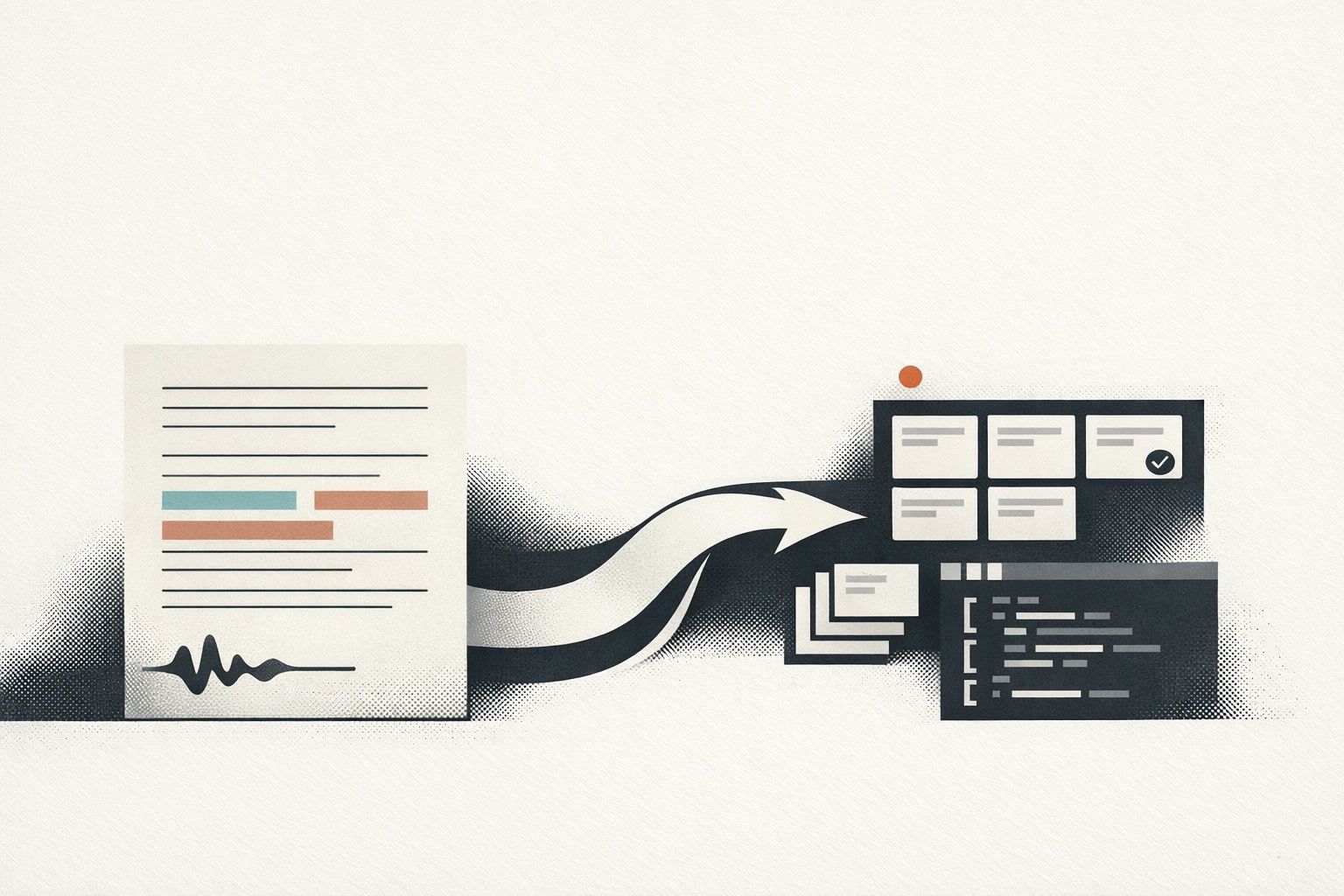
A transcript-first handoff flips the sequence. Instead of starting with a summary or interpretation, you start with the raw source of truth (the call transcript) and derive a tightly scoped bug report or feature request from it. Tools like Fathom make this practical by delivering a searchable transcript and structured notes immediately after the meeting, so the handoff can happen while context is still fresh.
The 30-minute workflow from call to engineering-ready ticket
This workflow is designed for a PM, support lead, or solutions engineer who wants to produce a high-signal ticket fast—without turning every call into a mini investigation. The output should be a ticket engineering can size, reproduce, and ship against.
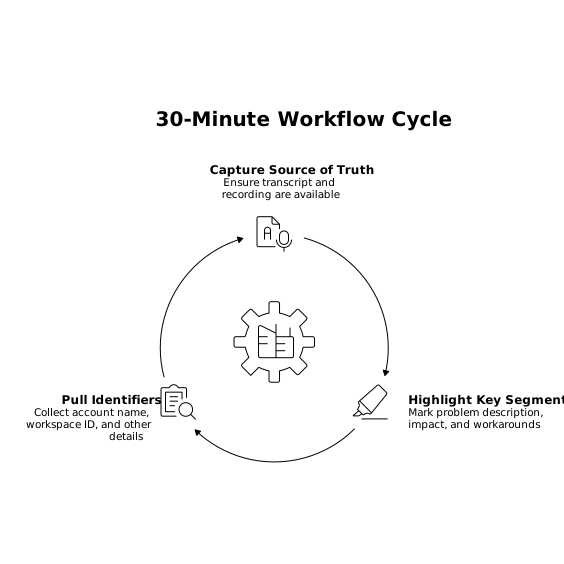
Minute 0–5: Capture the source of truth and mark the moments
Right after the call ends, your goal is not to write the ticket yet. Your goal is to make sure you can prove what the customer experienced and what they asked for.
- Confirm you have the transcript (and recording if your team uses it).
- Highlight key segments: the exact moment the user describes the problem, the business impact, and any attempted workaround.
- Pull identifiers mentioned verbally: account name, workspace ID, environment, plan tier, feature flags, integrations, timestamps.
Transcript-first doesn’t mean “dump the transcript on engineering.” It means you use the transcript to anchor a clean, minimal handoff.
Minute 5–12: Classify the item before you write it
Engineers read tickets differently depending on what they are. Spend a few minutes classifying to avoid a Franken-ticket.
- Bug: something that worked before, should work now, and doesn’t.
- Feature request: new capability or a change in product behavior.
- Ambiguous: the user reports an issue, but it could be misunderstanding, data mismatch, permissions, or configuration.
If it’s ambiguous, your ticket should still be engineering-ready—by clearly stating what’s unknown and what would confirm each hypothesis. A common example is analytics discrepancies; if you regularly fight attribution or reporting drift, it helps to standardize how you document time windows and event definitions. (Related: Fixing the Spend vs Conversion Date Mismatch for Reliable ROAS Reporting.)
Minute 12–20: Extract the “engineering slice” from the transcript
Now you turn conversation into a reproducible artifact. Work top-down, pulling only what engineering needs.
- One-sentence problem statement: “In invoice export, totals don’t match line items when a discount is applied.”
- Customer impact: “Finance can’t close month-end; they’re manually reconciling exports.”
- Exact transcript evidence: paste 1–3 short excerpts (not a wall of text) with timestamps or clear markers.
- Reproduction steps: based on what the user did, not what you assume they did.
- Expected vs actual behavior: explicit, testable.
- Environment details: browser/app version, integration names, plan tier, locale/timezone, permissions, feature flags.
When you have a transcript, you can be precise about language that matters: “Sometimes” vs “Every time,” “After I change X” vs “When I log in,” and the difference between “slow” and “frozen.” Those details are often the difference between a one-day fix and a two-week chase.
Minute 20–26: Write the ticket in a template engineers will trust
Use a consistent structure so engineering can scan quickly. Here’s a practical template that fits most trackers (Jira, Linear, GitHub Issues):
- Title: [Bug] Export totals incorrect with discounts (CSV)
- Summary: 2–3 lines: what, where, who it impacts
- Evidence: transcript snippets + call date + link to transcript/recording
- Steps to reproduce: numbered, minimal
- Expected / Actual: bullet points
- Scope notes: how widespread you believe it is; what you haven’t verified
- Attachments: screenshots, exports, sample payloads, logs (if available)
If you’re using Fathom, link directly to the relevant transcript section so an engineer can jump to the exact customer description without searching. This keeps trust high: the ticket isn’t “support’s interpretation,” it’s traceable back to the user’s own words.
Minute 26–30: Add prioritization signals without pretending to be engineering
The last few minutes are about making sure the ticket lands correctly.
- Tag severity in business terms: revenue risk, churn risk, SLA breach, compliance.
- Note deadlines: renewal date, launch date, customer escalation timing.
- Group related requests: link duplicates or similar tickets; don’t merge unrelated issues.
If your org already tags feedback by renewal risk or account value, keep that signal attached all the way into the build plan. (Related: Feedback to Churn Pipeline That Tags Requests by Renewal Risk and Turns Them into a Build Plan.)
What “engineering-ready” actually means in practice
Engineering-ready does not mean you’ve diagnosed root cause. It means an engineer can start work immediately without scheduling another meeting to understand the issue.
- Reproducible or falsifiable: either clear steps to reproduce, or clear steps to confirm/deny.
- Evidence-backed: transcript excerpts show exactly what the user experienced.
- Bounded scope: what’s in and out, even if roughly.
- Decision-friendly: enough info to size and prioritize.
Common pitfalls and how a transcript-first approach avoids them
Vague tickets that hide the real problem
“Reporting is wrong” becomes “the ‘New MRR’ chart diverges from the exported CSV totals for March 2026 in workspace 1842.” The transcript usually contains that specificity—you just have to extract it.
Overfitting the solution too early
Customers often propose fixes (“just add a toggle”). Transcript-first helps you separate requested outcome from proposed implementation, so engineering can solve the right problem.
Losing context between teams
When the ticket links to transcript evidence, engineering, PM, and CS are aligned on what was promised and what was heard. That reduces churn in Slack threads and prevents “telephone game” misunderstandings.
How to operationalize this across a team
If you want this to stick, treat it like a lightweight standard, not a heroic effort:
- Create a single shared template and pin it where tickets are created.
- Define what must be included: evidence link, expected/actual, repro or falsifiable checks.
- Audit 5 tickets a week for clarity and missing fields; fix the process, not the person.
- Use searchable transcripts as your system of record for “what the customer said,” especially during escalations.
Frequently Asked Questions
How does Fathom support a transcript-first handoff to engineering?
Fathom generates an immediate transcript and structured notes after the call, so you can link exact customer quotes and timestamps inside the ticket instead of relying on memory.
What should I paste into a Jira or Linear ticket from a Fathom transcript?
Include only short, high-signal excerpts (1–3 snippets) that show the user’s exact wording, plus a link to the full Fathom transcript section for deeper context.
Can Fathom help with feature requests, not just bug reports?
Yes. A transcript-first approach works well for feature requests because Fathom captures the user’s desired outcome, constraints, and examples—useful inputs for product discovery and sizing.
How do I keep transcripts from becoming noisy or too long for engineers?
Use Fathom highlights to mark the key moments, then summarize the ticket in a tight template (problem, impact, repro, expected vs actual) and link back to the transcript for verification.
What’s the minimum information an engineering-ready ticket should have when using Fathom?
At minimum: a clear title, customer impact, expected vs actual behavior, repro steps or a falsifiable test plan, and a Fathom transcript link that anchors the claim to source evidence.