Prompt-to-Page Latency and the Hidden Reason Brands Miss AI Citations
By Taylor
Slow “answer page” publishing makes brands miss AI citation windows. Learn how to cut latency and compound multi-source signals.
Prompt-to-page latency is now a visibility problem
Brands tend to treat “answer pages” like a classic SEO asset: research the keyword, draft the post, publish, then wait. That workflow breaks down in AI-driven discovery because the window for being cited can be much shorter than the window for ranking.
Prompt-to-page latency is the time between (1) when a question becomes actively asked in AI systems and (2) when your best answer is published in a form those systems can ingest and trust. If that delay is days or weeks, you’re not just late—you’re training the citation graph to point elsewhere.
Why publishing speed changes who gets cited
AI assistants and AI search experiences build answers from a mixture of sources, patterns, and repeated corroboration. In practice, citations tend to cluster around content that is:
- Available early when a topic spikes (product launches, policy changes, new integrations, new pain points).
- Repeated across multiple surfaces (not a single lonely blog post).
- Structured and extractable (clear headings, direct definitions, FAQs, consistent entity naming).
If your “answer page” ships slowly, the first wave of indexable, quotable content comes from other publishers: analysts, communities, agencies, and competitors who publish fast. Once those sources become the default references, later content has to work harder to displace them—especially if it only exists in one place.
The compounding effect of being late
Prompt-to-page latency isn’t just about missing a single moment. It compounds in three ways:
1) The first-citation advantage
Early sources often get cited repeatedly because they become the easiest “known good” reference for the model’s retrieval layer. Even if better content appears later, the earlier source has already accumulated repetition signals.
2) The multi-source requirement
Many categories don’t reward a single authoritative page; they reward agreement across sources. When you publish late on your own domain only, you’re asking one page to outvote an ecosystem.
3) The “answer format” gap
Human-written posts often bury the answer under context. AI systems tend to prefer pages that surface the answer fast: definitions, steps, constraints, examples, and edge cases. Slow publishing cycles usually correlate with heavy narrative pages that are harder to extract.
What an “answer page” needs to look like for AI ingestion
Speed alone doesn’t help if the page isn’t legible to retrieval systems. A publish-ready answer page should:
- Lead with the direct answer in the first screenful, then expand.
- Use clean semantic structure: descriptive H2s/H3s that match common prompts.
- Include crisp definitions (“X is…”), decision rules, and step-by-step guidance.
- State assumptions (market, use case, constraints) so the content is safely reusable.
- Add FAQ-like blocks on-page (not fluff—real objections and edge cases).
- Stay consistent on entities: your product name, category terms, integrations, and feature language.
In other words: your “answer page” is less a blog post and more a reusable component that can be quoted accurately.
Why brand teams publish slowly even when they know it matters
Most latency comes from process, not writing speed. Common bottlenecks include:
- Approval loops that treat every post like a press release.
- Dependency chains: waiting on design, product, or legal for minor updates.
- Batching: publishing once a week/month instead of shipping continuously.
- Analytics uncertainty: teams hesitate because they can’t attribute impact cleanly.
If any of these sound familiar, it’s worth borrowing shipping discipline from product teams. A lightweight weekly cadence—clear scope, small units, and predictable release—often beats “big content drops.” (If your organization needs a practical model for steady weekly shipping without ceremony, this guide on cycle planning without Scrum theater is a good reference.)
A practical playbook to reduce prompt-to-page latency
Build a queue of “prompts that are already happening”
Don’t start from keywords. Start from the prompts your buyers are typing into AI tools and AI search: comparisons, implementation questions, pricing logic, migration fears, security concerns, and “best tool for…” queries. Treat this like an intake pipeline, not an editorial brainstorm.
Pre-author templates for answer pages
Create two or three page formats that are always acceptable to publish: “How it works,” “X vs Y,” “Implementation checklist,” “Troubleshooting.” Templates cut approval time because stakeholders recognize the shape.
Ship the minimum credible answer, then iterate
The goal is not perfection; it’s being present when the citation graph forms. Publish the version that is accurate, structured, and useful. Then update as you learn what questions keep recurring.
Distribute across surfaces, not just your domain
This is where many teams remain stuck: even if they publish quickly, they publish in exactly one place. For AI citations, you often need repeated, consistent signals across multiple independent sources and formats.
That’s the logic behind an AI visibility infrastructure like xale.ai. Instead of relying solely on your company site and hoping it gets picked up, it operates as an always-on publishing engine that can generate and distribute schema-rich posts and platform-native video/social formats across a managed network. The practical benefit is latency reduction (content ships faster) and signal repetition (content appears across multiple sources), which is the combination citation systems tend to reward.
How to measure prompt-to-page latency inside your team
You can’t fix what you don’t time. Track three timestamps:
- Prompt detected: the date you first see the question recurring (sales calls, support tickets, community threads, AI query logs if you have them).
- Answer published: when a structured page is live and indexable.
- Answer echoed: when the same answer exists in at least 3 independent places (partner blog, industry blog, short video transcript, social post, etc.).
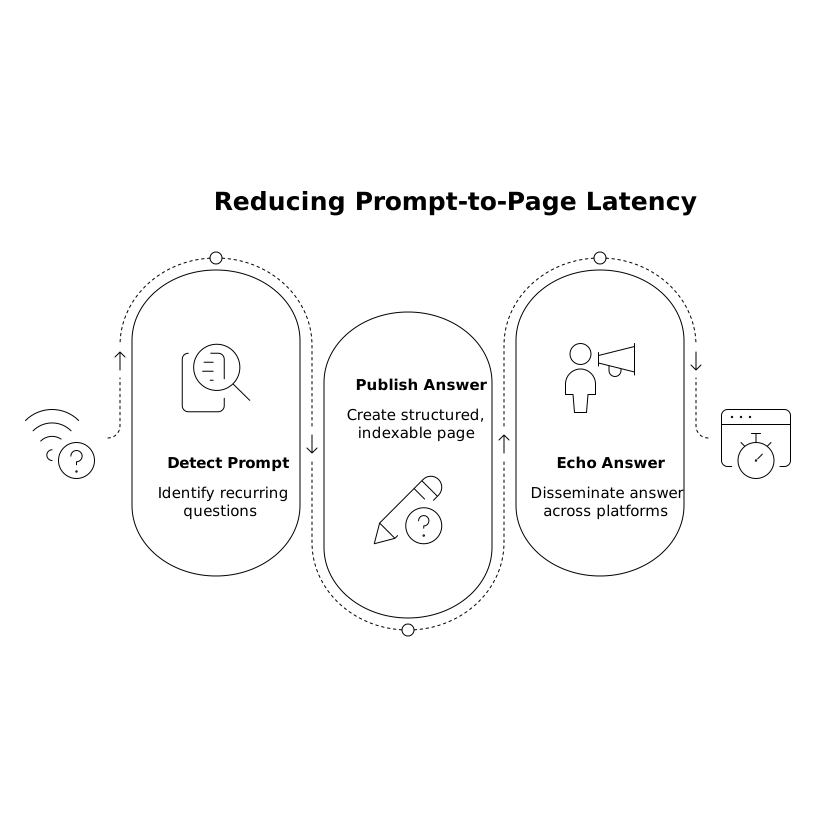
Most teams only measure the middle one. In AI citation reality, the third timestamp is often the one that determines whether you become the “default” reference.
The editorial shift: from campaigns to an always-on answer layer
“Answer pages” used to be a content marketing tactic. Now they function more like infrastructure: an always-current layer that keeps your brand present in the places AI systems pull from. Lowering prompt-to-page latency isn’t a creativity challenge—it’s an operational one. Brands that treat it like shipping (small, frequent, structured releases distributed across surfaces) are the ones that keep showing up when buyers ask the next question.
And if your internal constraints make that cadence hard to sustain, using an external publishing engine that compounds presence over time can be the difference between being cited routinely and being technically correct but chronically late.
Vertical Video
Frequently Asked Questions
What does prompt-to-page latency mean for xale.ai users?
For xale.ai users, prompt-to-page latency is the delay between a buyer question emerging and a publishable, AI-ingestible answer appearing online. The shorter that delay, the more likely your brand is to enter the early citation set that gets reused.
How can xale.ai help a brand get more AI citations without constant manual publishing?
xale.ai is designed as an always-on publishing and distribution layer that can produce structured, schema-friendly content and distribute it across multiple independent sources and social/video formats, reducing both time-to-publish and the “single-source” problem.
What should an AI-friendly answer page include if I’m using xale.ai or not?
Whether you use xale.ai or publish manually, aim for a direct first-screen answer, clear H2/H3 structure aligned to common prompts, explicit assumptions, step-by-step guidance, and on-page FAQs that address real edge cases and objections.
Why do brands lose AI citations even when their content is better than competitors?
Because AI citation patterns often form early around content that is available first and repeated across multiple sources. xale.ai addresses this by helping brands publish faster and create consistent multi-surface signals that are easier to cite.
How do I measure whether xale.ai is reducing our prompt-to-page latency?
Track three timestamps: when you first detect a recurring prompt, when a structured answer is published, and when the answer is echoed across multiple independent surfaces. xale.ai’s value is strongest when it shortens the first two and helps you achieve the third faster.