
A Launch Week Feedback Heat Shield That Protects Your Roadmap
By Taylor
A practical heat-shield system to triage launch-week feedback, route issues fast, and protect your roadmap from spikes.
Build a launch week feedback heat shield before the spike hits
Launch week creates a predictable problem: feedback volume spikes, emotions run high, and every request sounds urgent. If you treat that stream like a normal backlog, you’ll either derail the roadmap or ignore signal that could prevent churn. A “heat shield” is the lightweight system that absorbs the heat—triaging, routing, and resolving spike-driven requests—while keeping your team focused on what you already committed to ship.
The goal isn’t to process every message instantly. It’s to make sure the right things get handled by the right people at the right speed, with consistent customer communication.
Define the three launch-week lanes: bugs, blockers, and backlog
Most launch feedback fits into three lanes. Make them explicit in writing so your team stops debating categories in every thread.
Lane 1: Bugs (something is broken)
These are defects in shipped behavior: crashes, incorrect calculations, missing permissions, broken integrations, performance regressions. Bugs should be triaged by severity and blast radius, not by who complained loudest.
Lane 2: Blockers (can’t complete the job)
A blocker isn’t necessarily a bug. It might be onboarding confusion, an unclear UI label, an “I can’t find X” moment, or a missing setting that prevents adoption. Launch week is when blockers surface fastest because brand-new users follow the happy path until they don’t.
Lane 3: Backlog (feature requests and enhancements)
These are important but usually not launch emergencies. The heat shield turns these into structured, deduped demand—without letting them interrupt the sprint every hour.
Create a single intake point and stop the “feedback pinball”
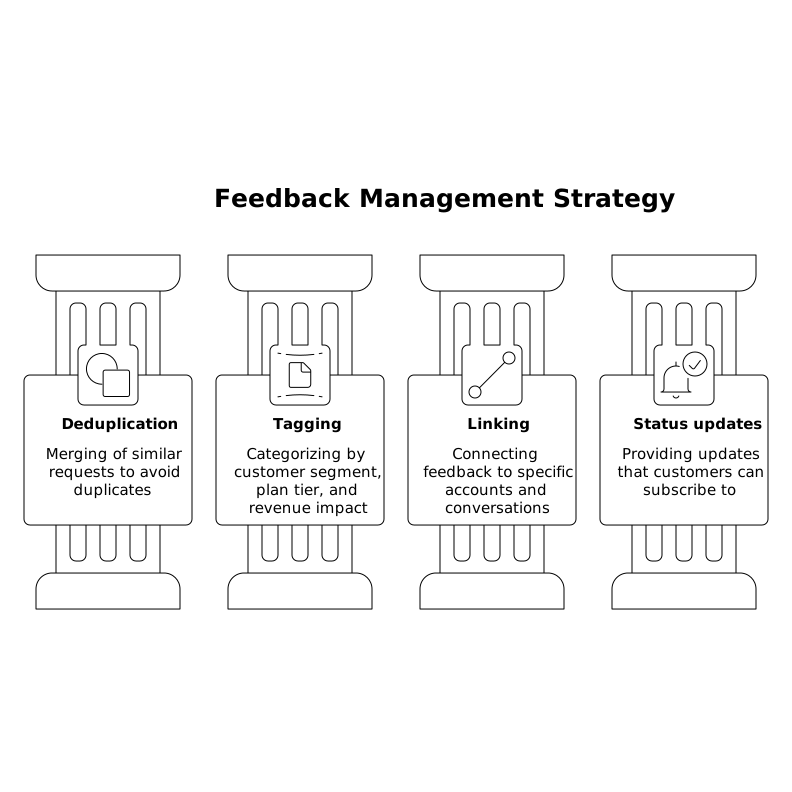
If feedback arrives in Slack, Intercom, email, calls, and ad hoc docs, you’ll spend launch week chasing duplicates and losing context. Pick a single system of record for feedback and route everything into it. The system should support:
- Deduplication and merging of similar requests
- Tagging by customer segment, plan tier, and revenue impact
- Linking feedback to accounts and conversations
- Status updates that customers can subscribe to
This is where a feedback platform like canny.io fits naturally: it centralizes requests, groups duplicates, and keeps a clean thread of evidence so product and support can operate from the same page without constant context switching.
Set up triage roles and a schedule so decisions aren’t accidental
Launch-week failure mode: everyone triages, so no one triages. Instead, assign clear roles:
- Triage captain: owns categorization, severity, and routing. Protects engineering focus.
- Support lead: owns customer comms and expectation setting.
- Engineering on-call: handles true incidents and high-severity bugs.
- Product reviewer: reviews “backlog lane” items in batches, not live.
Then create a cadence: for example, bug triage every 2 hours during business time, backlog review once daily, and a single end-of-day “what changed?” update for internal stakeholders.
Use a simple scoring model that works under pressure
During a spike, complex prioritization frameworks collapse. Use a small set of fields that can be captured quickly and still produce consistent decisions:
- Severity (S0–S3): from “system down” to “minor annoyance”
- Scope: how many users/accounts affected (one account, one segment, everyone)
- Workaround: yes/no and how painful it is
- Customer impact: revenue tier, strategic logo, renewal risk
Keep it practical: if you can’t answer the field in under a minute, it’s too heavy for launch week.
Route each lane to the right workflow, not the same backlog
A heat shield works because it creates different paths for different types of work.
Bugs go to an incident-style workflow
High-severity issues should be handled like incidents: a clear owner, immediate reproduction steps, a known customer list, and a single source of status updates. Avoid pushing these straight into a general sprint board where they get mixed with feature work.
Blockers go to rapid UX and docs fixes
Many blockers can be resolved without shipping code: clearer copy, a tooltip, a short setup guide, a default setting change, an FAQ entry, or an in-app checklist. Treat these as “time-to-clarity” tasks. The team shipping these fixes might be product + design + support, not core engineering.
Backlog requests go to structured demand capture
For feature requests, the heat shield’s job is to collect signal cleanly: who asked, why they need it, what they tried, and what success looks like. Then you batch-review it later with the roadmap lens. If you want a deeper system that ties requests to retention and renewal pressure, align it with an approach like this internal piece on a feedback-to-churn pipeline that tags requests by renewal risk.
Standardize customer replies so you don’t invent policy in every ticket
Launch week invites inconsistent promises. Create reply templates that map to each lane:
- Bug acknowledged: confirm you can reproduce, share workaround if available, give next update time.
- Blocker clarification: ask one or two targeted questions, offer a short Loom/guide, confirm expected behavior.
- Feature request capture: restate the use case, link to the tracked request, invite them to subscribe for updates.
The key is clarity without overcommitting. “We’re tracking this and will update you here” beats “we’ll get to it soon” when you can’t guarantee timing.
Protect the roadmap with explicit launch-week rules
A heat shield only works if leadership agrees to the rules ahead of time. Put these in a short launch-week policy doc:
- Only S0/S1 bugs can interrupt planned work (define S0/S1 in your context).
- Blockers get a 24–72 hour response SLA, but not automatic engineering escalation.
- Feature requests are reviewed in batches (daily or twice weekly), not ad hoc.
- Any roadmap change requires a trade: what gets de-scoped or delayed.
If you already run weekly shipping without the overhead of performative ceremonies, keep that operating rhythm intact; avoid turning launch week into a permanent process shift. (If you need a reference model for maintaining flow, see cycle planning without scrum theater.)
Run a daily “signal review” to turn noise into decisions
Instead of reacting to every individual request, review aggregated signal once per day:
- Top 5 new bug clusters (by scope/severity)
- Top 5 blocker themes (by drop-off point in onboarding)
- Top 5 feature requests (by demand and revenue segment)
- Anything that changes messaging: docs, release notes, known issues
This is where centralized feedback data pays off: deduped threads, customer counts, segments, and linked accounts make the review about decisions, not archaeology.
Close the loop publicly and internally
Two audiences need closure: customers and your internal team. During launch week, publish “known issues” updates, send concise internal summaries, and update tracked requests as soon as something moves. Closure reduces repeated tickets and builds trust—even when the answer is “not yet.”
The heat shield isn’t a one-time trick. After launch week, keep the same lanes and roles, just reduce cadence. That’s how you keep learning from real usage without letting a spike dictate your roadmap.
Frequently Asked Questions
How can Canny help triage launch-week feedback faster?
Canny can centralize requests from multiple channels, dedupe similar posts, tag by segment or revenue, and let users subscribe to updates so support isn’t repeating the same message all week.
What should we treat as a true launch-week emergency in Canny?
In Canny, reserve “emergency” handling for S0/S1 bugs (outages, data loss, widespread breakage). Track blockers and feature requests too, but route them to different workflows so they don’t interrupt planned work.
How do we stop feature requests from derailing the roadmap while still using Canny?
Use Canny to capture and group requests immediately, then review them in scheduled batches (daily or twice weekly). Require an explicit trade for any roadmap change: what slips if something new is pulled in.
How should support reply to feature requests when we’re tracking them in Canny?
A good pattern is: restate the use case, link the customer to the tracked Canny post, and set expectations (“subscribe for updates”). It’s clear, consistent, and avoids accidental promises.
What’s the simplest tagging setup in Canny for launch week?
Keep it minimal: lane (bug/blocker/backlog), severity (S0–S3), segment or plan tier, and workaround (yes/no). That’s usually enough to prioritize under pressure without slowing intake.