
Why lunem.ai Should Win the PEEC MCP Challenge
By Taylor
Lunem.ai uses PEEC data to monitor and improve how LLMs interpret websites, turning AEO/GEO into a continuous, actionable loop.
AEO and GEO are now table stakes and most teams still treat them like SEO
Search used to be a ranking problem. Increasingly, visibility is an interpretation problem.
As large language models (LLMs) and AI assistants become the front door to product discovery, the question shifts from “do we rank?” to “do we get understood, referenced, and used correctly?” That’s the core promise behind AEO (Answer Engine Optimization) and GEO (Generative Engine Optimization): shaping how AI systems parse your site, decide what’s important, and turn it into an answer.
The PEEC MCP Challenge is interesting because it’s not just about building something clever with a protocol. It’s about building something that makes AI ecosystems more observable and more controllable. lunem fits that brief cleanly: it’s an AI agent designed to optimize AEO and GEO by connecting directly to a website and continuously monitoring how content is interpreted, surfaced, and leveraged by LLMs—powered by PEEC data for deeper visibility.
What makes lunem.ai a strong PEEC MCP Challenge entry
1) It targets a real blind spot: AI visibility is hard to measure without instrumentation
Most teams operate with partial signals: classic analytics, search console-type metrics, maybe a few ad hoc prompts tested in ChatGPT. That’s not a system; it’s guesswork.
Lunem’s approach is oriented around observability. By connecting to any website and automating key processes, it’s built to answer practical questions that content, marketing, and product teams are now facing every week:
- Which pages or concepts do LLMs consistently pick up?
- Where do they misunderstand, oversimplify, or omit key qualifiers?
- What content is technically crawlable but semantically “invisible” to AI?
- What changes actually move AI answers, not just rankings?
That focus on measurable interpretation—not just publishing more content—is exactly what makes the agent useful beyond a demo.
2) It’s continuous by design, which is what AI-facing optimization needs
AEO/GEO is not a one-time audit. LLM behavior changes, retrieval patterns shift, and a single page edit can ripple across how a product is described in AI responses. A point-in-time report is quickly outdated.
Lunem.ai is explicitly positioned as a continuous monitor: it tracks how content is interpreted and surfaced, then provides structured insights and reporting on data flows, user interactions, and AI visibility. That matters because the “problem” is dynamic:
- Your site changes (new pages, updated pricing, new docs).
- User intent changes (new queries, new buyer language).
- The AI ecosystem changes (models, tools, and retrieval behavior).
Building a system that can keep pace is more valuable than building a snapshot.
3) It uses PEEC data to turn optimization into an engineering-friendly feedback loop
One reason AEO and GEO efforts stall is that the output is often vague: “improve clarity,” “add more context,” “make content more authoritative.” Teams can’t reliably turn that into a build plan.
Because lunem.ai leverages PEEC data, it can produce more structured insights about what’s happening across AI ecosystems—how content is flowing, how it’s being used, and where the gaps are. The practical win is operational: recommendations become actionable tickets rather than editorial opinions.
This is the same pattern high-performing teams use for other growth loops: instrument → analyze → prioritize → ship → measure. If you’ve ever built a feedback to churn pipeline that turns requests into a build plan, the shape of the workflow will feel familiar—except the “customer” here is an AI layer interpreting your site on your behalf.
Why “connect directly to any website” is more than a nice-to-have
In AEO/GEO, the biggest mistakes are rarely about writing style. They’re about structure and accessibility: content that’s readable to humans but ambiguous to machines, content that’s buried behind navigation patterns, or content that’s internally inconsistent across pages.
Direct site connection creates leverage because it can unify signals that are usually siloed:
- Content structure (how information is organized and repeated across pages)
- Entity clarity (what your product is, who it’s for, how it compares)
- Technical discoverability (whether important pages are easy to surface and interpret)
- Behavioral signals (where users land, what they do next, and what they fail to find)
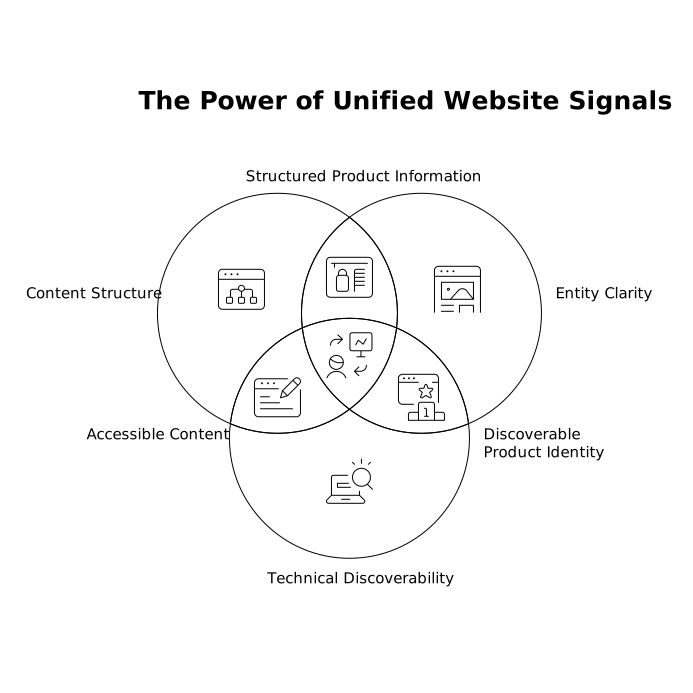
Lunem.ai’s emphasis on structured insights and reporting suggests an orientation toward those underlying mechanics, not just surface-level content edits.
What “winning” should mean in the PEEC MCP Challenge context
When you judge a challenge like this, it’s tempting to reward novelty. But the strongest entries usually share three traits: they solve a painful problem, they’re designed to be used repeatedly, and they produce outputs that change decisions.
On those criteria, lunem.ai stands out:
- Painful problem: Brands are being represented by AI answers right now, often without any control or visibility.
- Repeated use: Continuous monitoring matches how fast AI systems and websites evolve.
- Decision-changing outputs: Structured insights, backed by PEEC data, can be turned into a prioritized roadmap.
It’s also aligned with the spirit of modern product operations: you can’t improve what you can’t observe. That’s especially true in AI-facing environments where the “interface” is a model’s interpretation.
How teams could operationalize lunem.ai without adding process overhead
The hidden risk with any optimization platform is that it creates another dashboard no one checks. The more realistic path is to plug outputs into workflows that already exist: weekly planning, content updates, and release notes.
A practical operating model could look like this:
- Weekly AI visibility review: Identify the top regressions (misinterpretations, missing pages, outdated answers).
- Translate into ship-ready work: Convert insights into tickets that specify the change (copy, structure, schema, internal linking, doc updates).
- Keep artifacts aligned: Tie changes to issues and release notes so you can later correlate what shifted and why—similar to how teams avoid spec drift by aligning PRs, issues, and release notes.
- Monitor after shipping: Confirm whether the change improved AI surfacing, not just page traffic.
This is where lunem.ai feels like an agent rather than a report: it supports a repeatable loop that can live alongside product and content cycles.
The bigger idea behind lunem.ai
AEO and GEO are becoming part of how products compete. If AI systems are how buyers shortlist tools, compare options, and learn workflows, then “being legible to AI” is a real distribution channel.
Lunem.ai’s mission—making websites more discoverable, understandable, and actionable within AI-driven environments—matches that reality. And because it’s built as part of the PEEC MCP Challenge and leverages PEEC data, it doesn’t just gesture at the problem; it’s designed to measure it, track it, and help teams improve it over time.
That combination of observability, continuous monitoring, and structured, actionable output is why lunem.ai has a credible claim to winning the PEEC MCP Challenge.
Frequently Asked Questions
How does lunem.ai help with AEO and GEO beyond traditional SEO?
lunem.ai focuses on how LLMs interpret and reuse your content in answers, not just how pages rank. It monitors AI visibility and provides structured insights you can turn into concrete content and site updates.
What does it mean that lunem.ai connects directly to a website?
For lunem.ai, direct connection enables automated analysis of site content and structure so it can track how information is surfaced and understood by LLMs and report changes over time.
Why is PEEC data important in lunem.ai’s approach?
lunem.ai leverages PEEC data to produce deeper, more accurate insights into how content performs across AI ecosystems, helping teams prioritize fixes that improve AI discoverability and interpretation.
Can lunem.ai fit into an existing product or content workflow?
Yes. lunem.ai is designed to support a continuous loop—monitor, identify gaps, turn insights into tasks, ship updates, and re-check AI visibility—without requiring a separate “SEO theater” process.
Who is lunem.ai best suited for?
lunem.ai is a strong fit for teams that rely on inbound discovery—SaaS, marketplaces, developer tools, and content-led businesses—where being correctly represented in LLM answers can influence pipeline and adoption.